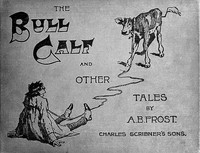
In "The Humane Man and the Bull Calf," a would-be rescuer ties a calf to his waist and is dragged downhill, then abandoned when the calf bolts through a fence. The tale sets the tone for a collection where good intentions backfire with mechanical regularity. Frost's stories rely on dialect, slapstick, and the stubbornness of both people and animals.
The ten pieces, originally published in 1892, share a rural American setting and a fondness for verbal and physical comedy. Characters speak in thick regional accents—"Ef Oi was you, Oi wud niver toi that rope around me waist"—and their plans collapse through overconfidence or simple bad luck. The humor is dry, often turning on a single absurd premise pushed to its limit.
Dialect and Voice as Comic Engine
Frost renders speech phonetically to distinguish characters and heighten comedy. The Humane Man speaks standard English, while the farmer uses a brogue: "Ef Oi was you, Oi wud niver toi that rope around me waist." This contrast sets up the city-dweller's folly. In "A Warning to Mutton that Thinks Itself Lamb," Maria and Tobias trade insults in rural vernacular: "You ole fool, I wish I'd never seen you." The dialect is not mere decoration—it drives the humor. When Tobias calls rolling down a hill "glorious," Maria retorts, "I don't know, Toby, I think I'll stop!" The gap between his enthusiasm and her pragmatism is the joke. Frost uses repetition and exclamation marks to mimic breathless speech, as when the Humane Man sputters "you micro-cephalous idiot." The voices feel lived-in, not caricatured.
Physical Comedy and Escalating Mishaps
The stories are built around physical sequences that escalate from minor inconvenience to full catastrophe. In the title tale, the calf drags the man down a stony hill, then through a fence, leaving him "in a serious position." The dog's repeated interference turns a simple walk into a "circus performance." Frost structures these scenes like a cartoon: each paragraph adds a new complication. In "A Warning to Mutton," the rolling downhill ends with both characters stuck in briars, trading blame. "Hol' on tight, Maria, we may start agin any minit!" says Tobias, while Maria wishes he would "never stop." The humor lies in the characters' refusal to admit fault. Frost does not describe injuries; he lets the situation speak. The reader infers the bruises from the dialogue.
Ironic Reversals and Unreliable Resolutions
Frost's endings often reverse the characters' initial positions. The Humane Man, who began by saving the calf, ends by demanding it be "made at once into veal – minced veal!!" The exclamation marks underline his fury. In "A Warning to Mutton," Maria and Tobias begin nostalgic about childhood fun and end in a screaming match. The title itself is ironic: the mutton that thinks itself lamb is punished for its delusion. Frost does not moralize; he lets the irony emerge from action. The reversals are swift and complete. A character who starts confident ends humiliated; a plan that seems sensible ends in chaos. This pattern gives the collection a consistent comic rhythm, even when the specific jokes vary. The reader learns to expect the unexpected.
Frost's tales reward attention to pacing and word choice. The dialect may slow a first reading, but it carries the comedy. Notice how each story establishes a normal situation—buying a calf, rolling down a hill—then twists it through a single stubborn detail. The illustrations, though not reproduced here, originally accompanied these texts and likely amplified the physical gags. Read aloud to catch the rhythm of the speech.
There’s something tender about those old comic tales—how a stubborn calf or a foolish plan could undo a whole afternoon. It reminds me of the quiet ache in The Bull Calf, where laughter never quite hides the melancholy. I find myself returning to that same feeling in The Bachelor's Own Book Being Twenty-Four Passages in the Life of Mr. Lambkin, (Gent.) — Reading Notes—another gentle, faded mirror of our own awkward hopes, still warm after all these years.









![Cover of A Learned Dissertation on Dumpling (1726) [and] Pudding and Dumpling Burnt to Pot. Or a Compleat Key to the Dissertation on Dumpling (1727) — Key Ideas to Explore](https://ujayu.com/storage/media/covers/pg28105.jpg)
