About 21 minutes
The Bull Calf, and Other Tales — A Closer Reading
Historical Psychological Social Fiction
4,654 recorded words. 2 minutes difference from this book's estimate.
View Gutenberg source #47735
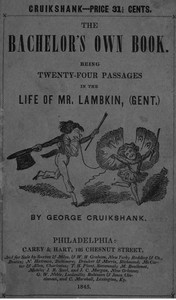
The source record for The Bachelor's Own Book Being Twenty-Four Passages in the Life of Mr. Lambkin, (Gent.) — Reading Notes measures this digital text at 4,369 words, 19 min estimated reading time, and 1 detected text section.
The text analysis averages about 21.7 words per sentence, while the detected sections provide another way to judge how the source is divided.
Project Gutenberg metadata also associates the work with “English wit and humor, Pictorial,” connecting these edition facts with the source record’s subject description.
Explore this collection
These alternatives are selected using recorded categories and estimated reading time.
About 21 minutes
Historical Psychological Social Fiction
4,654 recorded words. 2 minutes difference from this book's estimate.
View Gutenberg source #47735About 28 minutes
Historical Psychological Social Fiction
6,357 recorded words. 9 minutes difference from this book's estimate.
View Gutenberg source #44663About 35 minutes
Historical Psychological Social Fiction
7,979 recorded words. 16 minutes difference from this book's estimate.
View Gutenberg source #3175Search stored excerpts and compare books → Choose by your preferences →
Choices use stored catalog measurements. Estimates vary with reading speed. A shared category is a catalog label, not a claim that two books have the same argument or literary quality.
Search reads excerpt text stored with this catalog and links to its associated Gutenberg record. The connection is stored in the site database; this tool does not recheck that every excerpt is word-for-word identical to that external record. Excerpt search does not cover every chapter and does not verify historical publication dates.
Catalog snapshot checked: 2026-09-26. Coverage: 100 public books, 100 available source excerpts.
Calculated from edition completeness, EPUB availability, text structure and catalogue metadata. Not a user rating.
Total of 100 points, scaled to a 2.5-5.0 range. Editions with an empty description or a missing EPUB file are not scored.
Public-domain source text
The source text is kept in the dedicated reader, separate from this catalogue record and its commentary.
George Cruikshank's The Bachelor's Own Book (1845) traces the social fortunes of Mr. Lambkin across twenty-four illustrated plates, each captioned with a wry narrative summary. The work belongs to a tradition of comic serials that flourished in nineteenth-century England, where image and text collaborated to mock contemporary manners. Cruikshank, already celebrated for his illustrations of Dickens, here turns his hand to a self-contained sequence that follows a single protagonist through a series of escalating embarrassments.
The excerpts reveal a pattern of cause and consequence: Lambkin's vanity, his overindulgence in wine, and his clumsy attempts at romance repeatedly backfire. The captions carry a distinctive tone—mock-heroic in phrasing yet precise in social observation. For instance, Lambkin's intention to 'kill a certain Lady' is announced via placard by an envious rival, a detail that signals the public nature of his humiliations.
The sequence of plates builds a cumulative portrait of social failure. Plate 1 shows Lambkin 'upon the very best possible terms with himself' as he dresses; by Plate 2, his secret romantic ambition is exposed. The whitebait dinner in Plate 3—a luxurious affair at Blackwall—turns to physical distress in Plate 4, where 'something in the whitebait dinner' disagrees with him. The caption's parenthetical denial that the wine could be at fault ('could'nt possibly have been the wine') adds a layer of ironic self-deception.
This structure of rising action followed by deflation recurs. Plate 5 finds Lambkin attempting to be 'exceedingly amusing' at a picnic, only to succeed in making himself 'very ridiculous.' Plate 6 escalates further: at an evening party, his philandering offends his lady, and his violent polka dancing upsets 'poor old John, the coffee, and indeed, the whole party.' The pattern suggests a world where every assertion of confidence invites a corresponding humiliation.
After the party disaster, Lambkin's emotional state becomes the focus. Plate 7 shows him in Kensington Gardens, 'overwhelmed with shame and vexation,' burning with 'Rage, Jealousy, and revenge' upon seeing his lady with a rival. The caption notes he feels 'literally cut.' Plate 8 traces a rapid oscillation: from meditating 'desperate deeds of Duelling, Prussic Acid, Pistols, and Plunges in the River,' he cools to 'a quiet supper, a melancholy reverie, and a warm bath at the Hummums.' The next morning finds him at Epsom, where champagne and friends drive him to 'determine to live and die a Bachelor.'
This emotional whiplash—from suicidal thoughts to bachelor resolve—is rendered with a comic detachment that undercuts any genuine pathos. The bachelor's volatility becomes a source of humor rather than sympathy, a pattern that persists through later plates involving theatres, saloons, and a masquerade where he appears as Don Giovanni.
The captions frequently undercut Lambkin's self-image. He 'supports to perfection' the character of Don Giovanni at a masquerade, yet the reader is left to infer the gap between his self-assessment and reality. The phrase 'of course visits all the Theatres and all the Saloons' implies a predictable, almost mechanical pursuit of pleasure. Cruikshank's illustrations—though not reproduced in the text excerpts—would have amplified these ironies through facial expressions and bodily postures.
The work's subtitle, 'Being Twenty-Four Passages in the Life of Mr. Lambkin, (Gent.),' signals a mock-biographical structure. The parenthetical 'Gent.' is itself ironic, given Lambkin's consistent failure to behave as a gentleman. The plates function as a series of set-pieces, each a self-contained vignette of social misstep, yet together they form a coherent arc of bachelorhood as a state of perpetual, self-inflicted comedy.
Readers approaching The Bachelor's Own Book should attend to the interplay between caption and image, as the verbal text often supplies details that the etching may only imply. The work rewards attention to recurring motifs—dining, dancing, romantic pursuit—and to the escalating scale of Lambkin's disasters. It is a satire of masculine vanity and social pretension, rendered with Cruikshank's characteristic precision and wit.
That rainy afternoon, Mr. Lambkin’s fretful bachelorhood felt almost comforting in its absurdity. I closed the book, notebook open, and instead of writing notes, found myself drifting toward a shelf—somehow landing on This Giddy Globe — A Reader’s Guide, which quietly reframed all that etching-table fog into something gentler. Accidents like that are the best part of reading.
Use these questions to collect your thoughts before moving on.








![Cover of A Learned Dissertation on Dumpling (1726) [and] Pudding and Dumpling Burnt to Pot. Or a Compleat Key to the Dissertation on Dumpling (1727) — Key Ideas to Explore](https://ujayu.com/storage/media/covers/pg28105.jpg)
