About 35 minutes
Mark Twain's Burlesque Autobiography — Reading Companion
Historical Psychological Social Fiction
7,979 recorded words. 7 minutes difference from this book's estimate.
View Gutenberg source #3175
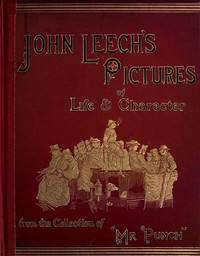
This digital edition of John Leech's Pictures of Life and Character, Volume 3 (of 3) From the Collection of "Mr. Punch" — Edition Insights is described by source-level measurements including 6,357 words, 28 min estimated reading time, and 8 detected text sections.
The text analysis averages about 9.8 words per sentence, while the detected sections provide another way to judge how the source is divided.
Project Gutenberg metadata also associates the work with “English wit and humor, Pictorial,” connecting these edition facts with the source record’s subject description.
Explore this collection
These alternatives are selected using recorded categories and estimated reading time.
About 35 minutes
Historical Psychological Social Fiction
7,979 recorded words. 7 minutes difference from this book's estimate.
View Gutenberg source #3175About 21 minutes
Historical Psychological Social Fiction
4,654 recorded words. 7 minutes difference from this book's estimate.
View Gutenberg source #47735About 19 minutes
Historical Psychological Social Fiction
4,369 recorded words. 9 minutes difference from this book's estimate.
View Gutenberg source #44434Search stored excerpts and compare books → Choose by your preferences →
Choices use stored catalog measurements. Estimates vary with reading speed. A shared category is a catalog label, not a claim that two books have the same argument or literary quality.
Search reads excerpt text stored with this catalog and links to its associated Gutenberg record. The connection is stored in the site database; this tool does not recheck that every excerpt is word-for-word identical to that external record. Excerpt search does not cover every chapter and does not verify historical publication dates.
Catalog snapshot checked: 2026-09-26. Coverage: 100 public books, 100 available source excerpts.
Calculated from edition completeness, EPUB availability, text structure and catalogue metadata. Not a user rating.
Total of 100 points, scaled to a 2.5-5.0 range. Editions with an empty description or a missing EPUB file are not scored.
Public-domain source text
The source text is kept in the dedicated reader, separate from this catalogue record and its commentary.
John Leech's Pictures of Life and Character, Volume 3 collects over 200 cartoons originally published in Punch between 1847 and 1864. The volume is a visual catalogue of Victorian social types—from the aspirational middle class to the rural poor—rendered with a sharp but affectionate eye. Leech's captions, often the only text, are terse and situational: a servant's complaint, a sportsman's mishap, a fashion victim's predicament. The catalog subject “English wit and humor, Pictorial” accurately describes the form, but the excerpts reveal a more specific focus on class performance, gender roles, and the absurdities of modern leisure.
The index lists nearly 200 titles, many naming a recognizable figure: “The Submissive Husband,” “An Afflicted One,” “A Shocking Young Lady Indeed.” These are not individuals but recurring social roles. The captions, as the transcriber notes, are drawn by the artist as part of each image, often a single line of dialogue or a label. For example, “Servantgalism” appears in multiple entries (Nos. XIII–XVI), suggesting a running gag about domestic staff. The humor depends on the reader's familiarity with Victorian class codes—the servant's impertinence, the master's bluster. Without the images, the captions feel fragmentary, but they point to a systematic observation of social performance.
A large cluster of titles references outdoor activities: “Across Country,” “Sketch at a Steeple Chase,” “Successful Angling,” “The Battue.” These are not action scenes but studies of participants—the anxious rider, the bored angler, the overeager shooter. The phrase “Spread of the Volunteer Movement—Scene, the Schoolroom” suggests a satirical take on military enthusiasm. Leech's interest lies in the gap between aspiration and reality: the amateur sportsman, the fashionable tourist. The beach appears repeatedly (“The Beach,” “Sketches at Brighton,” “Sou'-Wester in a Sea-side Lodging-House”), a setting where social pretensions are exposed by wind, water, and proximity to strangers.
Several entries focus on clothing as a source of humor: “Study of Crinoline,” “Studies of Crinoline during an Equinoctial Gale,” “The Spoon-shaped Bonnet.” Crinoline, the wide hoop skirt of the 1850s–60s, is treated as both a fashion statement and a physical hazard. The gale setting turns the skirt into a sail, a visual gag that Leech repeats. Other titles like “Beware of Artillery Whiskers” and “Another Pretty Little Americanism” show how fashion marks nationality and class. The captions likely deliver punchlines about vanity or discomfort. Leech's linework, praised for its nuance of expression, must convey the strain of maintaining dignity under ridiculous circumstances.
Because the text consists only of captions and titles, the reader must view the images to grasp the full joke. The index gives a sense of Leech's range—from domestic farce to sporting mishap—but the humor is visual. Approach this volume as a gallery of Victorian types, not a narrative. The catalog subject “English wit and humor, Pictorial” is accurate: the wit is in the drawing, and the humor is in the situation.
I have spent many slow afternoons with John Leech’s drawings, watching that sly Victorian grin at polite folly. There is a similar wink across the sea in New England Joke Lore: The Tonic of Yankee Humor — Edition Insights — not the same cut, but the same quiet knowing, two old friends sharing a nod over humanity’s little vanities.
A brief reflection can help important ideas stay with you longer.








![Cover of A Learned Dissertation on Dumpling (1726) [and] Pudding and Dumpling Burnt to Pot. Or a Compleat Key to the Dissertation on Dumpling (1727) — Key Ideas to Explore](https://ujayu.com/storage/media/covers/pg28105.jpg)
