About 364 minutes
The Land of Afternoon: A Satire — Inside the Classic
Fantasy Juvenile Worlds
83,614 recorded words. 8 minutes difference from this book's estimate.
View Gutenberg source #65560
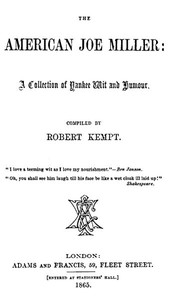
The source record for The American Joe Miller: A Collection of Yankee Wit and Humor — Inside the Classic measures this digital text at 81,814 words, 5 hr 56 min estimated reading time, and 12 detected text sections.
The text analysis averages about 16.3 words per sentence, while the detected sections provide another way to judge how the source is divided.
Project Gutenberg metadata also associates the work with “American wit and humor,” connecting these edition facts with the source record’s subject description.
Explore this collection
These alternatives are selected using recorded categories and estimated reading time.
About 364 minutes
Fantasy Juvenile Worlds
83,614 recorded words. 8 minutes difference from this book's estimate.
View Gutenberg source #65560About 302 minutes
Fantasy Juvenile Worlds
69,351 recorded words. 54 minutes difference from this book's estimate.
View Gutenberg source #37430About 295 minutes
Fantasy Juvenile Worlds
67,842 recorded words. 61 minutes difference from this book's estimate.
View Gutenberg source #41532Search stored excerpts and compare books → Choose by your preferences →
Choices use stored catalog measurements. Estimates vary with reading speed. A shared category is a catalog label, not a claim that two books have the same argument or literary quality.
Search reads excerpt text stored with this catalog and links to its associated Gutenberg record. The connection is stored in the site database; this tool does not recheck that every excerpt is word-for-word identical to that external record. Excerpt search does not cover every chapter and does not verify historical publication dates.
Catalog snapshot checked: 2026-09-26. Coverage: 100 public books, 100 available source excerpts.
Calculated from edition completeness, EPUB availability, text structure and catalogue metadata. Not a user rating.
Total of 100 points, scaled to a 2.5-5.0 range. Editions with an empty description or a missing EPUB file are not scored.
Public-domain source text
The source text is kept in the dedicated reader, separate from this catalogue record and its commentary.
Robert Kempt's The American Joe Miller (1865) is a jest-book that collects over 350 numbered anecdotes, puns, and comic dialogues, explicitly modeled on the British Joe Miller tradition. The compiler's preface argues that American humor is distinguished by 'broad exaggeration' and 'tall talk,' a claim the excerpts bear out: jokes often hinge on hyperbole, verbal misunderstandings, and the incongruous juxtaposition of high and low registers. The collection draws heavily on periodical literature, political satire, and regional stereotypes, with a noticeable concentration of jokes about lawyers, doctors, and marital strife.
Kempt's preface positions the book as a corrective to the absence of a dedicated American jest-book in England. He compares his work to Dean Ramsay's Scottish Reminiscences and Mark Lemon's English collections, asserting that American wit is 'essentially outré.' This framing is significant because it reveals the collection's intended audience: British readers curious about 'Brother Jonathan's' humor. The preface also offers a taxonomy of national humors—English intellectual, Scottish quaint, Irish hearty—but the excerpts themselves often blur these lines. For instance, joke #352 has a Yankee claiming Adam and Eve were 'Yankees, by thunder!'—a punchline that relies on the same kind of ethnic one-upmanship found in British or Irish jest-books.
Many entries turn on wordplay or the literal interpretation of idioms. Joke #354 has a broker asked his father's age and replying in stock-market terms: 'he is quoted at eighty, but there is every prospect he will reach par.' Joke #356 is a tour de force of acronymic satire, listing over twenty expansions of 'U. S.'—from 'Unconditional Surrender Grant' to 'Unabridged Seizure Grant'—all aimed at General Grant. This entry, drawn from the New York Herald, shows how the collection blends political commentary with the jest-book format. The Civil War appears in several jokes, such as #355, where Arkansas is the unwanted territory that prolongs the war, and #358, where a typographical error turns 'trains' into 'brains' in a general's report.
The excerpts reveal stock figures: the boastful Yankee, the henpecked husband, the literal-minded broker, and the pompous official. Joke #353 features a man who claims he is 'used to' boiler explosions because his wife has blown him up so often. Joke #357 has a man pleading that being a fool is 'a dreadful pull back to a man.' The collection also includes historical figures like William Penn and Thomas Story (#359), though the excerpt cuts off before the punchline. These recurring types suggest that Kempt organized his material by character or theme, though the full text would need to be consulted to confirm the arrangement. The jokes are short, rarely exceeding a paragraph, and rely on a single punchline—a structure that makes the collection easy to dip into.
Readers should approach The American Joe Miller as a period artifact rather than a timeless humor anthology. The jokes are uneven—some still land, others require historical footnotes. Pay attention to the sources Kempt credits (newspapers, anecdotes, other jest-books) and the way he frames American humor for a British audience. The collection offers a useful snapshot of mid-19th-century American comic sensibilities, especially the fondness for hyperbole and wordplay, but its value lies more in what it reveals about cultural stereotypes and publishing trends than in consistent laugh-out-loud comedy.
Somewhere between the numbered jests of Kempt’s collection and the quieter, stranger corners of humor, there’s a warmth I keep coming back to—the way a joke can hold a whole era’s voice. That same fondness lingers in The Sin of Monsieur Pettipon, and other humorous tales — A Closer Reading, where the laughter feels less like a punchline and more like an old friend sighing.
Use these questions to collect your thoughts before moving on.









