About 302 minutes
The Sin of Monsieur Pettipon, and other humorous tales — A Closer Reading
Fantasy Juvenile Worlds
69,351 recorded words. 7 minutes difference from this book's estimate.
View Gutenberg source #37430
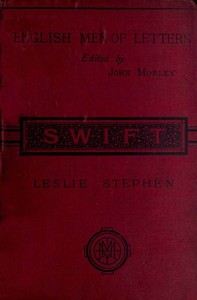
The catalog record for Swift — A Closer Reading provides practical reading context through 67,842 words, 4 hr 55 min estimated reading time, and 7 detected text sections.
The text analysis averages about 20.4 words per sentence, while the detected sections provide another way to judge how the source is divided.
Project Gutenberg metadata also associates the work with “Authors, Irish -- 18th century -- Biography,” connecting these edition facts with the source record’s subject description.
Explore this collection
These alternatives are selected using recorded categories and estimated reading time.
About 302 minutes
Fantasy Juvenile Worlds
69,351 recorded words. 7 minutes difference from this book's estimate.
View Gutenberg source #37430About 284 minutes
Fantasy Juvenile Worlds
65,221 recorded words. 11 minutes difference from this book's estimate.
View Gutenberg source #7028About 274 minutes
Fantasy Juvenile Worlds
62,923 recorded words. 21 minutes difference from this book's estimate.
View Gutenberg source #39114Search stored excerpts and compare books → Choose by your preferences →
Choices use stored catalog measurements. Estimates vary with reading speed. A shared category is a catalog label, not a claim that two books have the same argument or literary quality.
Search reads excerpt text stored with this catalog and links to its associated Gutenberg record. The connection is stored in the site database; this tool does not recheck that every excerpt is word-for-word identical to that external record. Excerpt search does not cover every chapter and does not verify historical publication dates.
Catalog snapshot checked: 2026-09-26. Coverage: 100 public books, 100 available source excerpts.
Calculated from edition completeness, EPUB availability, text structure and catalogue metadata. Not a user rating.
Total of 100 points, scaled to a 2.5-5.0 range. Editions with an empty description or a missing EPUB file are not scored.
Public-domain source text
The source text is kept in the dedicated reader, separate from this catalogue record and its commentary.
Leslie Stephen opens his biography of Jonathan Swift by immediately confronting the reliability of previous accounts. The preface catalogues earlier lives—Orrery's 'remarks,' Delany's 'observations,' Deane Swift's 'foolish and discursive' essay—and dismisses most as either biased or poorly informed. Stephen's own method is announced through his source criticism: he relies primarily on Swift's writings and correspondence, and on Scott's 1814 edition, which he calls 'by far the best account' despite its inaccuracies. This opening establishes a scholarly, skeptical tone that pervades the work.
Stephen does not simply narrate Swift's life; he evaluates the evidence at every turn. In the preface, he judges Orrery as 'more anxious to exhibit his own taste than to give full or accurate information,' and dismisses Deane Swift's book as 'foolish and discursive.' Even Johnson's life is 'meagre' and injured by prejudice. This relentless scrutiny sets the reader's expectations: Stephen will weigh sources, not merely repeat them. The biography thus becomes as much a historiographical exercise as a life story.
In the excerpt covering 1713, Stephen depicts Swift caught in the crossfire of ministerial intrigues. He describes Swift's pamphlets as 'indications of his state of mind'—one an attack on Bishop Burnet that 'finds out weak places enough,' the other a quarrel with Steele over party loyalty. Stephen notes the 'painful contrast' between Swift's earlier dignified arguments and his later 'scornful assault.' The narrative is driven by Swift's personal reactions: his 'sensibility to personal attacks,' his bitterness at Steele's ingratitude, and the cooling of his friendship with Addison. Stephen uses Swift's own words—'all our friendship is over'—to mark the emotional stakes.
Stephen devotes considerable space to the breakdown between Swift and Steele, treating it as a revealing episode. Steele's insinuation that Swift was an infidel 'stung Swift to the quick,' and Stephen analyses the psychology: Swift felt betrayed by a friend he had tried to protect, while Steele, 'the less prosperous combatant,' had 'a kind of right to bitterness.' The quarrel erupts just as Swift receives the deanery, linking personal and professional crises. Stephen's method here is to let the conflict unfold through letters and pamphlets, showing how political alignment fractured personal loyalty.
Throughout the preface and the later excerpt, Stephen repeatedly underscores the unreliability of firsthand accounts. Delany is 'the best contemporary authority, so far as he goes,' but even he is limited. The younger Sheridan, born in 1721, was 'still a boy when Swift was becoming imbecile.' Stephen warns that 'a number of more or less palpably fictitious anecdotes accumulated' around Swift. This caution primes the reader to treat all testimony with suspicion, and to value Stephen's own critical sifting of evidence.
Stephen's biography rewards a reader who attends to his source criticism as much as to Swift's story. The preface functions as a methodological key: every later claim about Swift's motives or actions should be measured against the reliability of the witness. The Steele quarrel, for instance, is not merely an anecdote but a test case of how political and personal loyalties interact. Reading with Stephen's skeptical eye turns the biography into a detective work on the nature of biographical truth itself.
Reading Swift reminded me of a rainy afternoon in a college library, puzzling over his letters, feeling the sting beneath the wit. I remembered how The Satires of Juvenal, Persius, Sulpicia, and Lucilius Literally translated into English prose, with notes, chronological tables, arguments, &c. — Text and Context gave me that same strange ache — fury worn so elegantly it nearly passes for calm, but never quite does. Both felt like holding a hand that’s politely pulling away. The Satires of Juvenal, Persius, Sulpicia, and Lucilius Literally translated into English prose, with notes, chronological tables, arguments, &c. — Text and Context lingers the same way.
Create a short personal record of your experience with this book.









