About 632 minutes
Cole's Funny Picture Book No. 1 — Reading Notes
Fantasy Juvenile Worlds
145,148 recorded words. 407 minutes difference from this book's estimate.
View Gutenberg source #30726
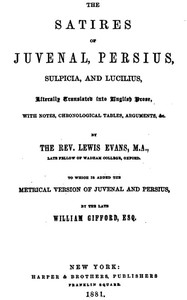
Before opening The Satires of Juvenal, Persius, Sulpicia, and Lucilius Literally translated into English prose, with notes, chronological tables, arguments, &c. — Text and Context, the edition data offers a quick orientation: 238,816 words, 17 hr 19 min estimated reading time, and 46 detected text sections.
The text analysis averages about 17.1 words per sentence, while the detected sections provide another way to judge how the source is divided.
Project Gutenberg metadata also associates the work with “Verse satire, Latin -- Translations into English,” connecting these edition facts with the source record’s subject description.
Explore this collection
These alternatives are selected using recorded categories and estimated reading time.
About 632 minutes
Fantasy Juvenile Worlds
145,148 recorded words. 407 minutes difference from this book's estimate.
View Gutenberg source #30726About 621 minutes
Fantasy Juvenile Worlds
142,641 recorded words. 418 minutes difference from this book's estimate.
View Gutenberg source #30480About 576 minutes
Fantasy Juvenile Worlds
132,321 recorded words. 463 minutes difference from this book's estimate.
View Gutenberg source #60562Search stored excerpts and compare books → Choose by your preferences →
Choices use stored catalog measurements. Estimates vary with reading speed. A shared category is a catalog label, not a claim that two books have the same argument or literary quality.
Search reads excerpt text stored with this catalog and links to its associated Gutenberg record. The connection is stored in the site database; this tool does not recheck that every excerpt is word-for-word identical to that external record. Excerpt search does not cover every chapter and does not verify historical publication dates.
Catalog snapshot checked: 2026-09-26. Coverage: 100 public books, 100 available source excerpts.
Calculated from edition completeness, EPUB availability, text structure and catalogue metadata. Not a user rating.
Total of 100 points, scaled to a 2.5-5.0 range. Editions with an empty description or a missing EPUB file are not scored.
Public-domain source text
The source text is kept in the dedicated reader, separate from this catalogue record and its commentary.
The translator's preface immediately announces a gap: no single prose translation of Juvenal had satisfied ordinary criticism. Evans positions his work as entirely original, not copying a line from previous versions. The opening thus frames the volume as a corrective, aiming to give the unclassical reader an adequate idea of the greatest of satirists. The excerpts that follow confirm this scholarly ambition: the notes are dense, explaining everything from the Tuscan soothsayer Ergenna to the dies lustricus for naming infants. A first-time reader should expect a translation that prioritizes fidelity over elegance, supported by apparatus that reconstructs the original context.
Evans begins by criticizing previous prose versions: Madan is faithful but unintelligible without the Latin; Sheridan is too free; others like Sterling or Nuttall could not serve as a basis. He claims his translation is entirely original, not copying a single line. This declaration sets expectations for a literal, scholarly rendering. The preface also reveals the volume's place in Harper's New Classical Library, a series of literal translations. Readers should note that the translator's goal is not poetic elegance but accurate representation of the satirists' meaning, with extensive notes to bridge the cultural gap.
The excerpts show a heavy apparatus of numbered notes. For example, a note on bidental explains the ritual for lightning-struck ground, citing Lucan and Horace. Another note on the evil eye describes amulets and references Virgil's Eclogues. The notes often quote Greek and Latin sources, such as Homer and Seneca, and explain Roman customs like the dies lustricus or the use of the middle finger as an insult. This density means the reader moves between text and footnote constantly. The notes are not merely glosses but mini-essays on religion, law, and daily life.
In the Persius excerpt, the satirist mocks misdirected prayers: parents pray for wealth and health while indulging in vice. The note explains that Persius ridicules those who render their own prayers impossible by their behavior. The passage includes a reference to the evil eye and the practice of anointing a child with saliva. The satirical target is superstitious ignorance and over-fondness. The notes clarify that the fifth day after birth involved sacrifices to Pilumnus and Picumnus, and that the dies lustricus was when the name was given. This section shows how the satirist combines moral critique with specific cultural practices.
The Juvenal excerpt includes a note on the phrase vellere barbam, alluding to Dionysius of Syracuse, and cross-references Satire I.133. Another note explains Licinus as the barber and freedman of Augustus, with an epigram quoted by Varro. The notes thus serve as a commentary on historical figures and literary allusions. For a first reading, the notes are essential: they identify references that would otherwise be obscure. The translator's aim is to make the satires accessible to readers without a classical education, but the density of annotation means the reading experience is as much scholarly as literary.
This edition is best approached as a reference work: read a satire first for its rhetorical force, then consult the notes for context. The translator's literal prose may lack the fire of verse, but the apparatus compensates by reconstructing the world the satirists attacked. The chronological tables and arguments at the start of each satire provide orientation. For a first reading, focus on the satirist's moral stance and the specific customs he targets; the notes will fill in the gaps.
Holding this dense translation, I remembered sitting with my grandfather’s old copy of Lucilius, underlining the same line twice—not because I understood it, but because the margin notes felt like someone else’s breath. Later, Humour of the North — Reading Companion gave me that same quiet ache, its laughter buried in annotations. Both books felt less like texts, more like rooms I could sit in alone.
Use these questions to collect your thoughts before moving on.









