About 564 minutes
The humour of Germany — Inside the Classic
Fantasy Juvenile Worlds
129,629 recorded words. 12 minutes difference from this book's estimate.
View Gutenberg source #69421
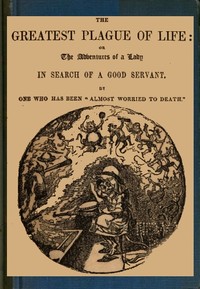
For The Greatest Plague of Life: or, the Adventures of a Lady in Search of a Good Servant. — A Closer Reading, the stored edition analysis reports 132,321 words, 9 hr 36 min estimated reading time, and 13 detected text sections.
The text analysis averages about 39.9 words per sentence, while the detected sections provide another way to judge how the source is divided.
Project Gutenberg metadata also associates the work with “English wit and humor,” connecting these edition facts with the source record’s subject description.
Explore this collection
These alternatives are selected using recorded categories and estimated reading time.
About 564 minutes
Fantasy Juvenile Worlds
129,629 recorded words. 12 minutes difference from this book's estimate.
View Gutenberg source #69421About 621 minutes
Fantasy Juvenile Worlds
142,641 recorded words. 45 minutes difference from this book's estimate.
View Gutenberg source #30480About 632 minutes
Fantasy Juvenile Worlds
145,148 recorded words. 56 minutes difference from this book's estimate.
View Gutenberg source #30726Search stored excerpts and compare books → Choose by your preferences →
Choices use stored catalog measurements. Estimates vary with reading speed. A shared category is a catalog label, not a claim that two books have the same argument or literary quality.
Search reads excerpt text stored with this catalog and links to its associated Gutenberg record. The connection is stored in the site database; this tool does not recheck that every excerpt is word-for-word identical to that external record. Excerpt search does not cover every chapter and does not verify historical publication dates.
Catalog snapshot checked: 2026-09-26. Coverage: 100 public books, 100 available source excerpts.
Calculated from edition completeness, EPUB availability, text structure and catalogue metadata. Not a user rating.
Total of 100 points, scaled to a 2.5-5.0 range. Editions with an empty description or a missing EPUB file are not scored.
Public-domain source text
The source text is kept in the dedicated reader, separate from this catalogue record and its commentary.
The narrator, a self-described married lady, opens with a mock-heroic lament on woman's lot, quoting the Rev. Robert Montgomery's poem "Woman an Angel!" and declaring Earth a "Vale of Tears." Her specific grievance: servants. The tone is arch and theatrical, blending sentimental cliché with sharp complaint. The first chapter proper introduces the servant problem through a series of exaggerated anecdotes, each servant more incompetent or dishonest than the last. Cruikshank's illustrations, mentioned in the list of plates, likely amplify the farcical tone.
The narrator's voice is the book's engine. She adopts the persona of a long-suffering wife and mistress, addressing "lovely daughters of Eve" as co-conspirators in domestic misery. Her language is florid and self-consciously literary: she quotes Shakespeare's "immortal Swan of Avon" and invokes "poor, dear, confiding Women" whose path is beset by "shoals and quicksands." Yet the hyperbole undercuts itself—she is clearly enjoying her own performance. The reader is invited to laugh at her plight while suspecting she exaggerates. This ironic distance is crucial: the book is not a sincere manual but a comic monologue.
The excerpts introduce a gallery of servant types, each a variation on incompetence or fraud. One servant is a former bear's-grease salesman named Dick Farden, whose father sold pig fat as "genuine bear's grease" using a stuffed bear skin. The narrative digresses into Farden's backstory—his father's pig farm, his own bankruptcy, and his turn to smuggling lace and cambric to ladies who cannot resist a bargain. This digression is typical: the book uses the servant hunt as a frame for picaresque tales of London lowlife. The humor lies in the contrast between the lady's genteel expectations and the rogues who answer her advertisements.
The book's structure mirrors a series of complaints or episodes. The table of contents lists sixteen chapters plus three introductions, suggesting a leisurely, anecdotal progression. Each chapter likely introduces a new servant and a new disaster. The narrator's voice provides continuity, but the real energy comes from the embedded stories—like Farden's—that veer into social satire. The subtitle "Adventures of a Lady in Search of a Good Servant" promises a quest, but the excerpts suggest the quest is a pretext for comic set-pieces. Readers should expect digressions, tall tales, and a narrator who is both victim and comic butt.
George Cruikshank's illustrations are integral to the book's effect. The list of plates includes a frontispiece titled "Nearly 'worried to Death' by the 'Greatest Plagues of one's Life'," which likely depicts the narrator beleaguered by servants. Cruikshank was known for his satirical and grotesque style, and his images would have underscored the farcical tone. The text itself is visual in its descriptions—the bear-skin display, the placard "Another fine young bear just slaughtered"—suggesting a collaboration between word and image. Readers should pause at each plate to see how Cruikshank interprets the narrator's complaints, often adding a layer of mockery or sympathy.
The book rewards readers who enjoy Victorian humor, social satire, and the spectacle of a narrator who is both sharp and ridiculous. Approach it as a series of comic sketches rather than a novel with a tight plot. The servant problem is real, but the treatment is anything but earnest. Let the narrator's voice carry you through the digressions, and watch for Cruikshank's visual jokes. The pleasure lies in the details: the fake bear grease, the bankrupt linen-drapers, and the lady who cannot stop complaining—or laughing.
That rainy afternoon, I kept laughing at the lady’s mounting despair over vanished jam and muddy footprints—yet a strange tenderness lingered. Cruikshank’s caricatures made every servant a rogue, but they were also, somehow, beloved. Later, I found myself reaching for Red Saunders' Pets and Other Critters — A Closer Reading, remembering how the same affectionate exasperation could be aimed at creatures who never learned.
Create a short personal record of your experience with this book.









