About 28 minutes
Mr. Jacobs: A Tale of the Drummer, the Reporter, and the Prestidigitateur — A Closer Reading
Science Fiction Utopias
6,285 recorded words. 2 minutes difference from this book's estimate.
View Gutenberg source #41125
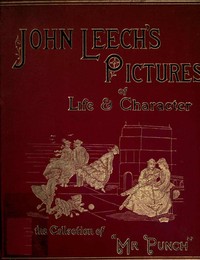
Before opening John Leech's Pictures of Life and Character, Volume 2 (of 3) From the Collection of "Mr. Punch" — Text and Context, the edition data offers a quick orientation: 6,692 words, 30 min estimated reading time, and 8 detected text sections.
The text analysis averages about 9.3 words per sentence, while the detected sections provide another way to judge how the source is divided.
Project Gutenberg metadata also associates the work with “English wit and humor, Pictorial,” connecting these edition facts with the source record’s subject description.
Explore this collection
These alternatives are selected using recorded categories and estimated reading time.
About 28 minutes
Science Fiction Utopias
6,285 recorded words. 2 minutes difference from this book's estimate.
View Gutenberg source #41125About 28 minutes
Science Fiction Utopias
6,213 recorded words. 2 minutes difference from this book's estimate.
View Gutenberg source #47176About 81 minutes
Science Fiction Utopias
18,460 recorded words. 51 minutes difference from this book's estimate.
View Gutenberg source #43419Search stored excerpts and compare books → Choose by your preferences →
Choices use stored catalog measurements. Estimates vary with reading speed. A shared category is a catalog label, not a claim that two books have the same argument or literary quality.
Search reads excerpt text stored with this catalog and links to its associated Gutenberg record. The connection is stored in the site database; this tool does not recheck that every excerpt is word-for-word identical to that external record. Excerpt search does not cover every chapter and does not verify historical publication dates.
Catalog snapshot checked: 2026-09-26. Coverage: 100 public books, 100 available source excerpts.
Calculated from edition completeness, EPUB availability, text structure and catalogue metadata. Not a user rating.
Total of 100 points, scaled to a 2.5-5.0 range. Editions with an empty description or a missing EPUB file are not scored.
Public-domain source text
The source text is kept in the dedicated reader, separate from this catalogue record and its commentary.
John Leech's Pictures of Life and Character, Volume 2 gathers over two hundred cartoons originally published in Punch between the 1840s and early 1860s. The volume is organized as an index of image titles and years, with each entry linking to a scanned illustration. The transcriber's note warns that the embedded text is nearly illegible at small sizes, urging readers to click through to the original-size images to catch the fine details and nuanced expressions that define Leech's observational humor.
Leech's targets range from fashion follies—such as the recurring 'Round Hat' and 'Sensible Riding Costume'—to social types like the blustering sportsman, the put-upon servant, and the anxious traveler. Recurring categories such as 'Servantgalism' and 'Railway Misery' suggest a sustained interest in class friction and technological disruption. The sheer range of subjects, from 'Academic Costume' to 'Zigzag,' makes this a dense visual record of mid-Victorian life.
Several entries in the index point to Leech's repeated use of stock characters and scenarios. 'Servantgalism' appears three times (1853, 1857, 1858), and 'Servantgalism and Fineladyism' once, indicating a running commentary on domestic hierarchies and the tensions between maids and mistresses. Similarly, 'Railway Misery' and 'Another Railway Misery' (1855, 1856) suggest a fascination with the discomforts and absurdities of train travel—a relatively new technology at the time. Other repeated motifs include 'The Seaside Circulating Library' (1847), 'Seaside Dialogue' (1856), and multiple 'At the Seaside' entries, showing Leech's fondness for coastal settings as a stage for social comedy. The recurrence of 'Adding Insult to Injury' (1845, 1857, 1859) hints at a running gag about escalating mishaps.
Leech frequently skewers Victorian fashion trends. Titles such as 'The Round Hat' (1855, 1856), 'A Startling Novelty in Shirts' (1853), and 'Sensible Riding Costume for Warm Weather' (1857) suggest a critical eye on both male and female attire. The entry 'As Well be out of the World as out of the Fashion' (1850) explicitly links fashion with social exclusion. The index also includes 'Artificial Ice—Grand Pas des Patineurs' (1850), which likely mocks the pretensions of ice-skating as a fashionable leisure activity. By juxtaposing 'Sensible Riding Costume' with 'Round Hat,' Leech seems to contrast practicality with absurdity, though without the images the exact nature of the satire remains inferred.
Sports and outdoor activities form a major category. Entries like 'Angling Delights' (1859), 'Aquatics—A Comfortable Randan' (1855), 'Something like Sport' (1854), and 'Sporting Intelligence' (1859) indicate a sustained interest in hunting, fishing, and boating. Yet the humor often lies in the gap between expectation and reality: 'A Rather Difficult Manouvre' at Aldershot (1859) and 'Shocking Result of wearing India rubber Goloshes' (1856) suggest physical comedy and mishap. The presence of 'Street Acrobat Nuisance' (1856) and 'Shuttlecock Nuisance' (1857) shows Leech also targeting public annoyances. The variety—from 'The Royal Knickerbocker Archers' (1859) to 'Table Turning Experiment at Greenwich' (1854)—reflects a broad curiosity about how Victorians spent their leisure time, often with ironic results.
Because this volume is essentially a visual index, readers are best served by browsing the images directly, using the index as a guide to themes that interest them. The transcriber's emphasis on viewing original-size images is well taken: Leech's line work and facial expressions carry the satire. Pay attention to recurring titles across different years—they reveal which subjects Leech returned to obsessively. The absence of explanatory captions in the text file means that the images themselves must do all the work, making this a pure exercise in visual reading.
I've spent many an afternoon among Leech's frantic Victorians, their bustles and blunders caught in ink. There's a warmth in their chaos, a shared joke between artist and reader. Oddly, that same unhurried smile surfaced in The Coming of Bill — Edition Insights, where the quieter moments speak just as loudly. Both books hold their era's breath, waiting for a knowing glance.
Use these questions to collect your thoughts before moving on.









