
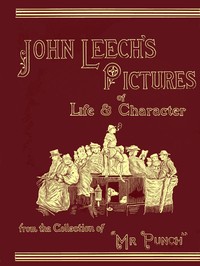
John Leech's Pictures of Life and Character, Vol. 3 (of 3) From the Collection of "Mr. Punch" — Key Ideas to Explore

(0 User reviews)   632
Leech, John, 1817-1864 Project Gutenberg 2014 Not confirmed
English wit and humor, Pictorial Readers of public-domain and historical texts
Project Gutenberg digital edition en

Edition facts

Words 22,881
Reading time 100 min
Text sections 9

For John Leech's Pictures of Life and Character, Vol. 3 (of 3) From the Collection of "Mr. Punch" — Key Ideas to Explore, the stored edition analysis reports 22,881 words, 1 hr 40 min estimated reading time, and 9 detected text sections.

The text analysis averages about 11.0 words per sentence, while the detected sections provide another way to judge how the source is divided.

Project Gutenberg metadata also associates the work with “English wit and humor, Pictorial,” connecting these edition facts with the source record’s subject description.

Explore this collection

Compare your next read

These alternatives are selected using recorded categories and estimated reading time.

Search stored excerpts and compare books → Choose by your preferences →

How these choices and excerpts are prepared

Choices use stored catalog measurements. Estimates vary with reading speed. A shared category is a catalog label, not a claim that two books have the same argument or literary quality.

Search reads excerpt text stored with this catalog and links to its associated Gutenberg record. The connection is stored in the site database; this tool does not recheck that every excerpt is word-for-word identical to that external record. Excerpt search does not cover every chapter and does not verify historical publication dates.

Catalog snapshot checked: 2026-09-26. Coverage: 100 public books, 100 available source excerpts.

John Leech's third volume of Punch cartoons captures Victorian life through sharp dialogue and visual gags, with a focus on domestic mishaps, social pretensions, and the absurdities of hunting, fashion, and childhood. The captions reveal a keen ear for dialect and class distinctions.
Share
Editorial Edition Score 4.7/5

Calculated from edition completeness, EPUB availability, text structure and catalogue metadata. Not a user rating.

How this score is calculated
  • Description quality20 pts
  • Title & short description10 pts
  • Source metadata20 pts
  • Text length15 pts
  • Chapters / structure15 pts
  • EPUB file integrity20 pts

Total of 100 points, scaled to a 2.5-5.0 range. Editions with an empty description or a missing EPUB file are not scored.

Edition quality

Public-domain source text

Read the source text

The source text is kept in the dedicated reader, separate from this catalogue record and its commentary.

John Leech's third volume of Pictures of Life and Character collects cartoons originally published in Mr. Punch, each a tightly framed social vignette. The captions are as essential as the drawings: Leech renders speech with phonetic precision—'Horfice,' 'Hinfantry Hadjutant'—and a relish for malapropism. A child asks if ancient Britons 'walked in the park and go to church' in their blue paint; a nurse is told to procure 'sponge-cakes and oranges' to manage a boy who 'can only be managed with kindness.' These are not mere jokes but compressed character studies, often hinging on a single line that deflates pretension or exposes a domestic absurdity.

Dialect and the Comic Voice

Leech's ear for class-inflected speech is the engine of his humour. Servants, tradespeople, and children speak in a thick, phonetic vernacular: 'Sich things as them,' 'I druv a fire-engine for two year,' 'Kitch 'old of my harm.' The effect is not cruel but theatrical—each character announces their station through their voice. A milkman defends thin cream by claiming 'the cream's at the bottom'; a cabby explains his reckless driving by his former trade. The jokes depend on the gap between what is said and what is meant, and Leech lets the speakers condemn themselves without editorial comment.

Domestic Skirmishes and Social Anxiety

Many cartoons turn on the friction between domestic roles. A wife discovers her husband's lie about dining at Greenwich; a governess is asked whether her crinoline constitutes her 'suburbs'; a 'treasure' of a housekeeper discards business letters because they are 'only from the horfice.' The humour is often at the expense of authority figures—parents, employers, officers—who are outwitted by children, servants, or their own vanity. Leech's world is one of constant, low-grade social negotiation, where a misplaced word or a too-revealing question can upend the expected order.

The Sporting Life as Theatre

Hunting, fishing, and volunteer drills provide a backdrop for physical comedy and masculine posturing. A hunter's horse is sent to the wrong station; a novice fisherman is warned of 'tremendous holes, fourteen or fifteen feet deep'; a volunteer is told not to 'stare about you as if you were in church.' The captions often undercut the dignity of the pursuit: a fox and hounds 'run into th' infant school,' and a groom complains that ladies 'knocks 'osses about so.' Leech treats sport not as a pastoral ideal but as a stage for incompetence, vanity, and the collision of expectation with reality.

Leech's captions reward slow reading: the humour lies in the timing of the punchline and the specific vocabulary of each speaker. Pay attention to the names—'Hon. Tom Rasper,' 'Old Mr. Wiggles'—which often signal the character's type. The volume is best approached as a gallery of voices, each cartoon a miniature play in one or two lines. The absence of narrative context means the reader must infer the situation from the dialogue alone, a skill Leech's original audience would have brought from their own daily encounters with Victorian life.

Leafing through Leech’s hunting mishaps, I’m back in my grandfather’s armchair, laughing at a similar absurdity in Irish Wit and Humor Anecdote Biography of Swift, Curran, O'Leary and O'Connell — Themes and Context—that same gentle poke at human vanity. Both books feel like old friends whispering that our follies are, after all, quite survivable.

There are no reviews for this eBook.

0
0 out of 5 (0 User reviews )

Add a Review

Your Rating *
There are no comments for this eBook.

Reader reflection

Before you leave, reflect on the book

Use these questions to collect your thoughts before moving on.

Your progress 0 / 10
1

What is your current status with this title?

2

How did the book work for you overall?

3

Would you encourage someone else to read it?

4

How demanding did the text feel?

Related eBooks









