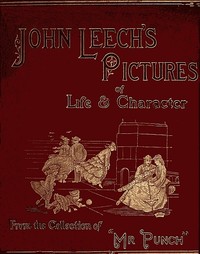
John Leech's Pictures of Life and Character, Vol. 2 collects cartoons from Mr. Punch where the humor often hinges on the interplay between image and caption. Leech's captions are not mere labels; they are miniature dramatic scenes, complete with stage directions in parentheses. A young gentleman's apology is noted parenthetically; a conductor's alacrity is described; a cook's complaint is rendered in a breathless, unpunctuated monologue. These verbal choices reveal Leech's ear for class-inflected speech and his interest in the gap between what characters say and what they mean.
Dialogue as Social Barometer
Leech's characters speak in distinct registers that signal their social standing. The 'Old Party from the Country' wheezes and stammers, while the conductor replies with breezy familiarity: 'ALL RIGHT, OLD BOY! JUMP IN!' The cook in 'A Pretty Kettle of Fish' strings together a litany of 'heggs,' 'breakfastes,' and 'bashawed lobsterses,' her malapropisms and dropped h's marking her as a servant overwhelmed by Puseyite fasting rules. At the other end of the scale, the 'Irritable Old Gentleman' sputters with rage, his speech punctuated by dashes and oaths. Leech uses these verbal tics not for mere mockery but to create a taxonomy of Victorian voices, from the flustered rustic to the imperious master.
The Caption as Dramatic Aside
Many captions include parenthetical stage directions that comment on the action. In 'None but the Brave Deserve the Fair,' Augustus says 'NOW, I'VE GOT YOU!' with no further note, but in 'Compliments of the Season,' Reynard the Fox's speech is followed by 'HERE'S AN OLD-FASHIONED CHRISTMAS, MY BOYS, FOR YOU, AND MANY OF 'EM.' The parentheses often reveal a character's true feelings: the groom in 'Touching' sobs, and the stage direction 'Is relieved by tears' undercuts the sentimental scene. This technique gives the captions a theatrical quality, as if Leech is directing a tiny play on the page.
Repetition and Variation in Series
Leech occasionally builds humor through serial repetition. The sequence 'If You Want a Thing Done, Do It Yourself' runs through seven variations, each showing the master absurdly performing servants' tasks: cleaning stables, polishing boots, carrying coals, even minding the brougham in fog. The joke escalates as the master's efforts become more ridiculous, culminating in the suggestion to hire an organ-grinder for the domestics' amusement. Similarly, the mistletoe motif recurs across multiple cartoons, with variations on the kissing custom: a pretty cousin complains of a scratched chin, a child asks about 'Kissmas time,' and Mr. Punch claims his reward under the mistletoe. These series demonstrate Leech's ability to mine a single situation for multiple comic angles.
Wordplay and Juvenile Etymology
Leech occasionally indulges in explicit wordplay, as in 'Juvenile Etymology,' where Master Jack asks if 'Kissmas time' is so named because 'everybody kisses everybody under the mistletoe.' The humor lies in the child's literal-minded logic, which the caption neither confirms nor denies. In 'Where Ignorance Is Bliss,' a streetwise exchange has one speaker ask 'Vot's a panic?' and the other reply 'Blow'd if I know; but there's von to be seen in the City.' The pun on 'panic' as a financial term and a person named Panic is left for the reader to parse. These moments show Leech trusting his audience to catch the verbal cleverness without explicit explanation.
Readers of this volume should attend to the captions as carefully as the images. Leech's verbal choices—the dialect, the parenthetical asides, the serial structures—are not afterthoughts but integral to the comedy. The cartoons reward slow reading, where the interplay of word and image reveals layers of social observation. This edition preserves the original captions in full, allowing modern audiences to hear the voices of Victorian London as Leech imagined them.
Leafing through Leech’s careful captions, I remembered my grandfather chuckling over a Punch annual, the same quiet amusement I later found in The Hohenzollerns in America With the Bolsheviks in Berlin and Other Impossibilities — Inside the Classic—that gentle absurdity where manners collide with chaos, yet nobody raises their voice. Both felt like eavesdropping on a joke told many times, still warm.