About 69 minutes
Humour of the North — Reading Companion
Fantasy Juvenile Worlds
15,740 recorded words. 10 minutes difference from this book's estimate.
View Gutenberg source #25041
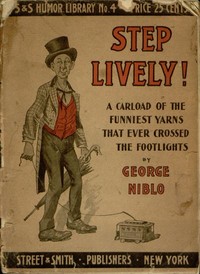
This digital edition of Step Lively! A Carload of the Funniest Yarns that Ever Crossed the Footlights — A Closer Reading is described by source-level measurements including 17,946 words, 1 hr 19 min estimated reading time, and 4 detected text sections.
The text analysis averages about 16.0 words per sentence, while the detected sections provide another way to judge how the source is divided.
Project Gutenberg metadata also associates the work with “American wit and humor,” connecting these edition facts with the source record’s subject description.
Explore this collection
These alternatives are selected using recorded categories and estimated reading time.
About 69 minutes
Fantasy Juvenile Worlds
15,740 recorded words. 10 minutes difference from this book's estimate.
View Gutenberg source #25041About 69 minutes
Fantasy Juvenile Worlds
15,782 recorded words. 10 minutes difference from this book's estimate.
View Gutenberg source #48245About 67 minutes
Fantasy Juvenile Worlds
15,217 recorded words. 12 minutes difference from this book's estimate.
View Gutenberg source #78197Search stored excerpts and compare books → Choose by your preferences →
Choices use stored catalog measurements. Estimates vary with reading speed. A shared category is a catalog label, not a claim that two books have the same argument or literary quality.
Search reads excerpt text stored with this catalog and links to its associated Gutenberg record. The connection is stored in the site database; this tool does not recheck that every excerpt is word-for-word identical to that external record. Excerpt search does not cover every chapter and does not verify historical publication dates.
Catalog snapshot checked: 2026-09-26. Coverage: 100 public books, 100 available source excerpts.
Calculated from edition completeness, EPUB availability, text structure and catalogue metadata. Not a user rating.
Total of 100 points, scaled to a 2.5-5.0 range. Editions with an empty description or a missing EPUB file are not scored.
Public-domain source text
The source text is kept in the dedicated reader, separate from this catalogue record and its commentary.
George Niblo's Step Lively! presents itself as a stage performance, opening with the narrator addressing the audience directly: 'There, there, there! Don't make such a racket or you'll make me nervous.' The book's subtitle promises 'a carload of the funniest yarns that ever crossed the footlights,' and the text delivers a series of comic monologues and sketches. Niblo's persona is a self-described 'nonsensical man' who recounts absurd anecdotes, from a geography lesson where a student defines a strait as 'beats three of a kind' to a grocer's customer ordering 'paralysed sugar' and 'condemned milk.' The humor relies on wordplay, dialect, and the narrator's deadpan delivery.
The book's structure mimics a vaudeville routine. The narrator opens by acknowledging the audience's laughter and immediately establishes a rapport: 'That's right. Laugh at me. Oh, I dearly love to see people's faces wreathed in smiles.' This framing device recurs throughout, with the narrator interrupting his own stories to comment on the telling. For instance, he begins a story about a dirty window but stops, saying 'I guess I'd better not. You wouldn't see through it, anyway.' Such meta-commentary reinforces the performative nature of the text. The excerpts show that Niblo's humor often depends on the audience's imagined reactions, creating a sense of shared amusement.
Niblo's humor frequently turns on linguistic misunderstandings and absurd premises. In the geography lesson, a student's poker-inspired definition of 'strait' subverts the teacher's expectations. Similarly, a customer's grocery list includes 'paralysed sugar,' 'condemned milk,' and 'desecrated codfish,' while the grocer responds with perfect seriousness. The narrator's own stories often hinge on improbable situations: he walks twenty miles to thrash a fellow 'just for fun' and ends up in an ambulance; a hotel clerk telephones to warn him of a fire, then chides him for swearing 'there are ladies in the next room.' These episodes rely on logical twists rather than slapstick, rewarding readers who appreciate clever misdirection.
Many of Niblo's yarns are set during his travels, particularly in Ohio and North Carolina. He describes visiting a country school, an apothecary shop, and a friend's home, each setting providing fodder for comedy. The narrator's observations often highlight the gap between expectation and reality: a 'retired home of the settler' turns out to be a 'tumble-down cabin,' and a friend's child swallows marbles. These details ground the humor in recognizable, if exaggerated, domestic and social situations. The book's episodic structure—each anecdote relatively self-contained—makes it suitable for browsing, much like a collection of stage monologues.
Readers approaching Step Lively! should expect a series of loosely connected comic sketches rather than a continuous narrative. The humor is rooted in early 20th-century American vernacular and stage traditions, so some references may require context. Niblo's persona is central: he is both the narrator and the butt of his own jokes. Pay attention to the framing devices and wordplay, which are the book's chief pleasures.
There’s something tender about Niblo’s old monologues—their brisk puns and dialect still carry a faint echo of laughter in a gaslit room. It makes me think of the quieter craft behind such performances, the deliberate mechanics of timing and delivery. Tricks of the trade — Edition Insights seems to sit beside that memory, like a stagehand’s notebook found years later, gently explaining what the audience never saw.
Capture what you thought, learned, and would like to remember.









