About 364 minutes
The Land of Afternoon: A Satire — Inside the Classic
Fantasy Juvenile Worlds
83,614 recorded words. 98 minutes difference from this book's estimate.
View Gutenberg source #65560
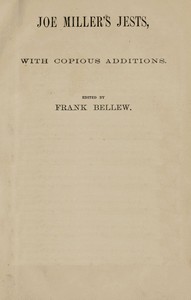
The source record for Joe Miller's Jests, with Copious Additions — Reading Notes measures this digital text at 106,188 words, 7 hr 42 min estimated reading time, and 11 detected text sections.
The text analysis averages about 23.2 words per sentence, while the detected sections provide another way to judge how the source is divided.
Project Gutenberg metadata also associates the work with “English wit and humor,” connecting these edition facts with the source record’s subject description.
Explore this collection
These alternatives are selected using recorded categories and estimated reading time.
About 364 minutes
Fantasy Juvenile Worlds
83,614 recorded words. 98 minutes difference from this book's estimate.
View Gutenberg source #65560About 564 minutes
Fantasy Juvenile Worlds
129,629 recorded words. 102 minutes difference from this book's estimate.
View Gutenberg source #69421About 356 minutes
Fantasy Juvenile Worlds
81,814 recorded words. 106 minutes difference from this book's estimate.
View Gutenberg source #43996Search stored excerpts and compare books → Choose by your preferences →
Choices use stored catalog measurements. Estimates vary with reading speed. A shared category is a catalog label, not a claim that two books have the same argument or literary quality.
Search reads excerpt text stored with this catalog and links to its associated Gutenberg record. The connection is stored in the site database; this tool does not recheck that every excerpt is word-for-word identical to that external record. Excerpt search does not cover every chapter and does not verify historical publication dates.
Catalog snapshot checked: 2026-09-26. Coverage: 100 public books, 100 available source excerpts.
Calculated from edition completeness, EPUB availability, text structure and catalogue metadata. Not a user rating.
Total of 100 points, scaled to a 2.5-5.0 range. Editions with an empty description or a missing EPUB file are not scored.
Public-domain source text
The source text is kept in the dedicated reader, separate from this catalogue record and its commentary.
Frank Bellew's 1865 edition of Joe Miller's Jests opens with a paradox: the titular wit was, by contemporary accounts, "taciturn and saturnine," a comic actor whose own dullness made his name a byword for stale humor. The preface recounts a dinner party where a story was dismissed as an "old Joe"—yet none present had actually seen the book. This gap between reputation and reality shapes the entire collection, which Bellew frames as a rescue mission for a work more cited than read.
The preface explicitly states that Miller "was himself a jest for dulness," calling the attribution "sarkasum" (sarcasm). This self-aware irony recurs in the jests themselves: jest 709 features a colonel who claims to be his own captain, lieutenant, and cornet, only to be undercut by a duchess who adds "And trumpeter also, I presume." The pattern suggests that the collection's humor often targets pretension, including its own. Bellew's editorial note that the original 1739 title page was "most humbly inscribed" to figures like Alexander Pope and Orator Henley further underscores the jestbook's playful self-positioning within a specific social and literary milieu.
Many jests hinge on quick verbal exchanges that expose or invert social rank. In jest 707, a clergyman confused during horse-trade testimony deflects a bullying lawyer's insult by contrasting "a bully and a bull," noting that a bull has horns while the bully "luckily for me, has none." Jest 711 records Henry Erskine's gallant reply to the Duchess of Gordon: when she calls Edinburgh "vile dull," he retorts that the sun might as well refuse to rise. These exchanges rely on wit as a social equalizer, allowing the lower-status speaker to land the final word. The collection's structure—brief, punchy anecdotes—privileges the repartee over narrative buildup.
Several jests share thematic threads. Horses appear repeatedly: in jest 706, Sir Isaac Heard flatters King George III by calling his horse "Perfection" because "he bears the best of characters," a pun on the horse's name and the king's favor. Jest 707 again involves a horse, this time in a legal dispute. Irish dialect humor surfaces in jest 703, where a check-taker explains the Queen's incognito visit by saying she came "clane and dacent like another lady." The frequency of such motifs—animals, courtrooms, and linguistic misunderstandings—suggests the jestbook's reliance on familiar comic situations rather than original invention, reinforcing its role as a compendium of circulating jokes.
Readers approaching this edition should note that the jests are not arranged by theme or quality; they accumulate in a loose, almost random sequence. The pleasure lies less in individual punchlines than in observing the recurring social dynamics—the put-down, the misunderstanding, the self-deprecating twist. Bellew's preface invites us to treat the book as a historical artifact, a window into what counted as clever in 18th- and 19th-century company, rather than as a reliable source of timeless humor.
There’s something tender in how Bellew’s edition half-apologizes for Joe Miller, as if the joke’s on the man himself. It reminds me of leafing through The humour of Germany — Inside the Classic, where the laughter feels just as layered, just as wistful about who gets credited for a good punchline. Old jestbooks hold that ache quietly, don’t they?
Capture what you thought, learned, and would like to remember.









