About 227 minutes
His Lordship's Leopard: A Truthful Narration of Some Impossible Facts — Reading Notes
Adventure Picaresque Fiction
52,016 recorded words. 9 minutes difference from this book's estimate.
View Gutenberg source #30873
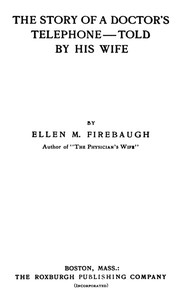
Before opening The Story of a Doctor's Telephone—Told by His Wife — A Reader’s Guide, the edition data offers a quick orientation: 54,217 words, 3 hr 56 min estimated reading time, and 7 detected text sections.
The text analysis averages about 11.9 words per sentence, while the detected sections provide another way to judge how the source is divided.
Project Gutenberg metadata also associates the work with “Wit and humor,” connecting these edition facts with the source record’s subject description.
Explore this collection
These alternatives are selected using recorded categories and estimated reading time.
About 227 minutes
Adventure Picaresque Fiction
52,016 recorded words. 9 minutes difference from this book's estimate.
View Gutenberg source #30873About 250 minutes
Adventure Picaresque Fiction
57,438 recorded words. 14 minutes difference from this book's estimate.
View Gutenberg source #44739About 257 minutes
Adventure Picaresque Fiction
58,991 recorded words. 21 minutes difference from this book's estimate.
View Gutenberg source #6836Search stored excerpts and compare books → Choose by your preferences →
Choices use stored catalog measurements. Estimates vary with reading speed. A shared category is a catalog label, not a claim that two books have the same argument or literary quality.
Search reads excerpt text stored with this catalog and links to its associated Gutenberg record. The connection is stored in the site database; this tool does not recheck that every excerpt is word-for-word identical to that external record. Excerpt search does not cover every chapter and does not verify historical publication dates.
Catalog snapshot checked: 2026-09-26. Coverage: 100 public books, 100 available source excerpts.
Calculated from edition completeness, EPUB availability, text structure and catalogue metadata. Not a user rating.
Total of 100 points, scaled to a 2.5-5.0 range. Editions with an empty description or a missing EPUB file are not scored.
Public-domain source text
The source text is kept in the dedicated reader, separate from this catalogue record and its commentary.
The telephone, Firebaugh argues in her opening, has not quieted the doctor's nights but amplified them. Where once a thunderous knock might rouse the household, now the phone rings at all hours, often for trivial questions. The narrator traces the incremental installation of two phone systems—city and Farmers'—and the decision to connect them, a move that turns the home into an extension of the office. This is not a technical history but a wry domestic chronicle: the phone becomes a character in its own right, dictating sleep, meals, and the rhythms of family life.
The book opens by contrasting the old days—a horse's gallop, a neighbor's knock—with the new: a telephone that “makes the thunderous knocks of old pale into insignificance.” Firebaugh details how the doctor first installs a phone in his office, then adds one at home for night calls. The result is more frequent disturbances, as people find it easier to call than to dress and travel. The narrator notes that “several people do the same thing in the same night, as frequently happens.” The phone, meant to connect, instead invades. The doctor's solution—connecting the two phones so his wife can relay messages—only tightens the tether. The prose is precise about the mechanics: the doctor “had an idea” to link them, and Mary becomes an unpaid operator, keeping “an ear on the 'phone” while he is out.
One of the longest excerpted episodes follows Mary and the doctor on a house call. Thirsty, Mary tries to politely ask a deaf old man for water; he mishears and sends his granddaughter with a plate of peaches. The comedy escalates: the girl forgets a knife, Mary requests water, and the girl draws it from a well bucket—only for the doctor to arrive, furious, because the house has typhoid fever. He drives off in a huff, leaving Mary to imagine the girl's astonishment. The scene is rich with specific details: the “low-branched pine” blocking the view, the “creaking well-sweep,” the Black-eyed Susan that “caught the smile in her eyes.” Firebaugh uses the episode to show how a simple errand becomes a farce of miscommunication and marital tension, all triggered by the doctor's rushed schedule.
The Project Gutenberg catalog lists this work under “Wit and humor” and “Physicians -- Anecdotes.” The excerpts bear this out: the tone is consistently comic, with the narrator's voice dry and observant. However, the humor is not the punchline-driven kind of a joke book but situational, built on the friction between technology and human behavior. The “anecdotes” are not isolated; they form a continuous narrative about a marriage and a profession. The catalog's secondary topic “general-literature” is accurate but vague. Notably absent from the catalog is any mention of the wife's perspective as a framing device. The title itself—Told by His Wife—signals a domestic viewpoint that the catalog subjects do not capture. Readers expecting a collection of doctor jokes will find instead a sustained, novel-like account of how a telephone reshapes a household.
Firebaugh's book is best approached as a hybrid: part memoir, part social commentary, part marital comedy. The telephone is both subject and McGuffin, a device that exposes the strains of a doctor's life and the resilience of his wife. Readers should pay attention to the narrator's asides—her observations about flowers, her silent arguments with her husband—as they reveal a personality that the phone cannot quite silence.
There’s something about a household reshaped by a ringing phone—how a life gets pulled in directions no one planned. It reminded me of another quiet sort of upheaval, where a simple assignment turns into something far more tangled. Psmith, Journalist — Edition Insights carries that same lingering warmth, the chaos unfolding gently, like a memory you’re glad to keep.
Your answers remain private and are stored only in this browser.




![Cover of The three sisters [Night watches, Part 6.] — A Closer Reading](https://ujayu.com/storage/media/covers/pg12156.jpg)




