About 257 minutes
Three Men and a Maid — Reading Notes
Adventure Picaresque Fiction
58,991 recorded words. 7 minutes difference from this book's estimate.
View Gutenberg source #6836
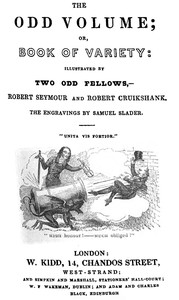
For The Odd Volume; Or, Book of Variety — Reading Companion, the stored edition analysis reports 57,438 words, 4 hr 10 min estimated reading time, and 7 detected text sections.
The text analysis averages about 25.3 words per sentence, while the detected sections provide another way to judge how the source is divided.
Project Gutenberg metadata also associates the work with “English wit and humor,” connecting these edition facts with the source record’s subject description.
Explore this collection
These alternatives are selected using recorded categories and estimated reading time.
About 257 minutes
Adventure Picaresque Fiction
58,991 recorded words. 7 minutes difference from this book's estimate.
View Gutenberg source #6836About 236 minutes
Adventure Picaresque Fiction
54,217 recorded words. 14 minutes difference from this book's estimate.
View Gutenberg source #38752About 267 minutes
Adventure Picaresque Fiction
61,202 recorded words. 17 minutes difference from this book's estimate.
View Gutenberg source #2607Search stored excerpts and compare books → Choose by your preferences →
Choices use stored catalog measurements. Estimates vary with reading speed. A shared category is a catalog label, not a claim that two books have the same argument or literary quality.
Search reads excerpt text stored with this catalog and links to its associated Gutenberg record. The connection is stored in the site database; this tool does not recheck that every excerpt is word-for-word identical to that external record. Excerpt search does not cover every chapter and does not verify historical publication dates.
Catalog snapshot checked: 2026-09-26. Coverage: 100 public books, 100 available source excerpts.
Calculated from edition completeness, EPUB availability, text structure and catalogue metadata. Not a user rating.
Total of 100 points, scaled to a 2.5-5.0 range. Editions with an empty description or a missing EPUB file are not scored.
most tremble for what was to ensue. Still I hoped the best; and I, at last, sat down, with the resigned idea that time would try all.
The Odd Volume opens with a preface that frames itself as a successor to the popular Cruikshank at Home series, but with a twist: a dispute between the Cruikshank brothers led to a change in title and the introduction of Robert Seymour as illustrator. This backstory sets the tone for a collection that revels in eccentricity and variety. The very first tale, “Legend of the Large Mouth,” introduces a narrator who encounters a man with a mouth so grotesque it defies description—a mouth that “turned full upon me as I entered” during a yawn. The prose is deliberately hyperbolic, piling up comparisons to moons and freemason’s aprons, establishing a voice that is both playful and macabre.
The opening story establishes a pattern of exaggerated physical description that borders on the monstrous. The large-mouthed man is described with a head “villainous low,” hair like bell-ropes, and eyes “the smallest and most porkish of all possible eyes.” The mouth itself is a “rustic basement” to the “superstructure of his facial horrors.” This blend of architectural metaphor and animalistic detail recurs throughout the volume. In “The Elopement,” the ghostly nuns are not merely spooky but actively mischievous: they “twitched and pinched” maids, drained cows of milk, and caused horses to “prance and snort.” The humor is coarse and physical, treating supernatural terror as a kind of practical joke. The prose often shifts between high-flown language and blunt, almost slapstick imagery, creating a tonal dissonance that is characteristic of the collection.
Contrasting with the grotesque tales are passages of vivid sporting description, such as the extended hunting scene on the Dalwhinnie Moors. The prose becomes rhythmic and expansive, following a sportsman whose “unerring eye never glanced along brown barrel” and who brings down birds “like lead on the heather.” The landscape is rendered in sweeping terms: “bright black boundless Dalwhinnie Moors, stretching away, by long Lock-Erricht-side, into the dim and distant day.” The pointers are named and described individually—Mungo, Don, Clara, Primrose, Basto, Nimrod—each with a distinct color. This attention to detail suggests a writer deeply familiar with the subject, yet the passage is framed as an excerpt from Blackwood’s Magazine, hinting at the volume’s patchwork origins. The shift from grotesque inns to open moors illustrates the deliberate variety promised by the title.
The volume’s preface openly acknowledges its own constructed nature, noting that the engravings were originally intended for a fourth volume of Cruikshank at Home but were repurposed due to a “disagreement between the two brothers Cruikshank.” The preface also introduces Seymour as a “gentleman of far superior talent” who will manage future volumes, a claim that reads as both advertisement and inside joke. The table of contents lists titles that range from the absurd (“Inconveniencies Resulting from Being Hanged”) to the domestic (“Strawberries and Cream”). This miscellany is held together by the illustrators’ work; the engravings by Cruikshank and Seymour are integral to the book’s identity. The text itself is a patchwork of genres—legend, farce, sporting sketch, ghost story—unified by a tone of knowing, slightly chaotic humor.
Readers approaching the Odd Volume should expect no overarching plot or consistent narrator. Instead, the pleasure lies in the abrupt shifts in register and subject, from the grotesque to the pastoral, the supernatural to the mundane. The illustrations by Cruikshank and Seymour are not mere decorations but part of the book’s DNA; the text often seems written to complement the images. Treat each piece as a standalone curiosity, and pay attention to the way the prose oscillates between high-flown description and blunt comedy—a tension that defines the volume’s peculiar charm.
Holding this odd volume, I remembered my grandfather's shelf of curiosities, where The Odd Volume felt like a friend’s whispered secret. That same thrill of impossible truths surfaced later in His Lordship's Leopard: A Truthful Narration of Some Impossible Facts — Reading Notes, a book that let me sit quietly with its contradictions, much like these old sketches.
Create a short personal record of your experience with this book.




![Cover of The three sisters [Night watches, Part 6.] — A Closer Reading](https://ujayu.com/storage/media/covers/pg12156.jpg)




