
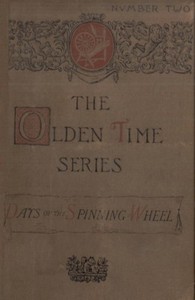
The Olden Time Series: Vol. 2: The Days of the Spinning-Wheel in New England
Forget kings and generals for a moment. The Days of the Spinning-Wheel in New England is about the bedrock of history: how people lived. Henry M. Brooks acts as our guide, sifting through the attic of America's past to show us the tools, tasks, and tiny dramas of everyday life in the early 1800s.
The Story
There isn't a single narrative. Instead, think of it as a series of vivid snapshots. Brooks collects anecdotes, recipes, household tips, and snippets from long-forgotten town records and personal journals. We see how families turned flax and wool into linen and yarn on their own spinning wheels. We learn about 'bees'—not for honey, but for quilting, apple-paring, and raising barns—where work was mixed with gossip and courtship. The book walks us through a year's cycle of chores, from maple sugaring in spring to preparing winter stores in autumn. It's the story of a community where nearly everything was made by hand, close to home.
Why You Should Read It
This book has a quiet magic. It makes you appreciate the incredible skill and effort embedded in the simplest historical objects—a homespun shirt, a hand-dipped candle. Brooks has a great eye for the quirky, human detail: the superstition about bread rising, the exact method for making ink from oak galls, the debates over the best way to cure a ham. It’s not a dry list of facts; it’s a collection of lived experiences. Reading it, you gain a deep respect for the ingenuity and endurance of ordinary people, especially women, whose domestic labor was the engine of early American life. It connects you to a tangible, tactile past that often gets left out of the history books.
Final Verdict
Perfect for history buffs who prefer kitchens to battlefields, for crafters and homesteaders curious about traditional skills, or for anyone with New England roots wanting to picture their ancestors' world. It’s also a great, bite-sized read for a slower evening, the literary equivalent of paging through a great-grandparent's scrapbook. If you enjoy the feel of real history in your hands, you'll find this second volume of the Olden Time Series to be a genuine and absorbing treasure.
This book is widely considered to be in the public domain. It is available for public use and education.
Donald Gonzalez
2 years agoI had low expectations initially, however the plot twists are genuinely surprising. Thanks for sharing this review.
Lucas Lopez
4 months agoThe fonts used are very comfortable for long reading sessions.
Emma Perez
11 months agoLoved it.





Jennifer Hill
1 year agoIf you enjoy this genre, the content flows smoothly from one chapter to the next. Don't hesitate to start reading.