
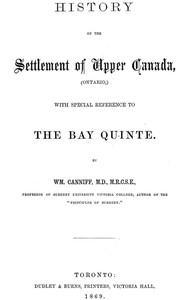
History of the settlement of Upper Canada (Ontario,) by William Canniff
Let's be clear from the start: this isn't a novel. There's no single hero on a quest. Instead, William Canniff's "History of the Settlement of Upper Canada" is a massive, room-by-room tour of Ontario's earliest foundations. Published in 1869, Canniff was a doctor and historian who collected stories, documents, and personal accounts from the children and grandchildren of the first pioneers.
The Story
The book begins with the land before major settlement, looking at the Indigenous peoples and the very first French and British traders and soldiers. But its real heart is in the late 1700s and early 1800s, after the American Revolution. That's when thousands of Loyalists—people who wanted to remain British—flooded north. The book follows them as they claim plots of forest along lakes and rivers. Canniff describes the sheer, back-breaking work: felling giant trees, building log shanties, planting the first crops among stumps. He tracks the arrival of later waves of immigrants from Britain, Ireland, and Europe, showing how communities slowly formed, arguing over where to put roads and schools and churches. It's the story of how scattered cabins became villages, and how villages grew into the skeleton of the modern province.
Why You Should Read It
I love this book because it makes history personal and physical. Canniff doesn't just say "settlers faced hardships." He tells you about families burning their own furniture for warmth in a January cold snap, or grinding peas into a kind of coffee because the real stuff was impossible to get. You get a real sense of the smells, the sounds, and the constant labour. It also doesn't shy away from the conflicts—between neighbours, between different ethnic groups, and between the settlers and the colonial government. It’s messy, complicated, and fascinating. Reading it, you start to see the landscape differently. That old stone farmhouse or that oddly straight county road suddenly has a story that goes back 200 years.
Final Verdict
This is a book for a specific but curious reader. It's perfect for anyone with deep roots in Ontario who wants to understand where their family might have fit into the bigger picture. It's also great for local history buffs, genealogy enthusiasts, or anyone who enjoys slow, detailed nonfiction that builds a world piece by piece. It's not a breezy read—it's dense and packed with names and places—but if you have the patience, it's incredibly rewarding. Think of it less as a book to read cover-to-cover, and more as a rich reference to dip into, a conversation with a very knowledgeable, slightly old-fashioned storyteller about where we all came from.
You are viewing a work that belongs to the global public domain. You can copy, modify, and distribute it freely.
Jennifer Miller
7 months agoAs a long-time follower of this subject matter, the argument presented in the middle section is particularly compelling. Definitely a five-star contribution to the field.
Susan Flores
1 year agoCitation worthy content.
David Miller
9 months agoPerfect.


David Hernandez
10 months agoUnlike many other resources I've purchased before, the cross-referencing of different chapters makes it a great study tool. I'll be citing this in my upcoming project.