About 76 minutes
Much Darker Days — Story, Setting & Ideas
Historical Psychological Social Fiction
17,298 recorded words. 7 minutes difference from this book's estimate.
View Gutenberg source #21933
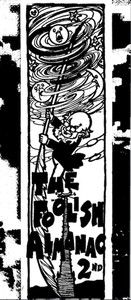
The catalog record for The Foolish Almanak for Anuthur Year The Furst Cinc the Introdukshun ov the Muk-rake in Magazeen Gardning, and the Speling Reform ov Owr Langwij by Theodor Rosyfelt — Story, Setting & Ideas provides practical reading context through 15,793 words, 1 hr 9 min estimated reading time, and 4 detected text sections.
The text analysis averages about 14.5 words per sentence, while the detected sections provide another way to judge how the source is divided.
Project Gutenberg metadata also associates the work with “American wit and humor,” connecting these edition facts with the source record’s subject description.
Explore this collection
These alternatives are selected using recorded categories and estimated reading time.
About 76 minutes
Historical Psychological Social Fiction
17,298 recorded words. 7 minutes difference from this book's estimate.
View Gutenberg source #21933About 60 minutes
Historical Psychological Social Fiction
13,591 recorded words. 9 minutes difference from this book's estimate.
View Gutenberg source #26053About 81 minutes
Historical Psychological Social Fiction
18,558 recorded words. 12 minutes difference from this book's estimate.
View Gutenberg source #28105Search stored excerpts and compare books → Choose by your preferences →
Choices use stored catalog measurements. Estimates vary with reading speed. A shared category is a catalog label, not a claim that two books have the same argument or literary quality.
Search reads excerpt text stored with this catalog and links to its associated Gutenberg record. The connection is stored in the site database; this tool does not recheck that every excerpt is word-for-word identical to that external record. Excerpt search does not cover every chapter and does not verify historical publication dates.
Catalog snapshot checked: 2026-09-26. Coverage: 100 public books, 100 available source excerpts.
Calculated from edition completeness, EPUB availability, text structure and catalogue metadata. Not a user rating.
Total of 100 points, scaled to a 2.5-5.0 range. Editions with an empty description or a missing EPUB file are not scored.
Public-domain source text
The source text is kept in the dedicated reader, separate from this catalogue record and its commentary.
The Foolish Almanak announces itself with a title page that mocks spelling reform and muckraking, crediting 'Theodor Rosyfelt' as author. The opening greeting declares that 'only the Foolish Almanack has been equal to the pleasant Task of Killing' Time, setting a tone of irreverent parody. The January page offers a 'Helpful Hint' against vain regrets, then lists eclipses with a wry political comment: 'the time is now about ripe for us to get it in the neck again.' The almanac mixes mock-serious astronomical predictions with absurd household recipes and pun-filled verses, all in a phonetic spelling that satirizes contemporary reform movements.
The most immediate feature of the Foolish Almanak is its orthography. Words are respelled phonetically: 'anuthur,' 'furst,' 'introdukshun,' 'ov,' 'owr,' 'langwij.' This is not random error but a deliberate parody of the spelling reform movement championed by Andrew Carnegie and others in the early 1900s. The title page credits 'Theodor Rosyfelt'—a caricature of President Theodore Roosevelt, who supported simplified spelling. The joke is reinforced by the note 'WITH APOLOGIZ TO THE KARNAGY SPELING SKOOL.' The misspellings are consistent enough to suggest a system, yet absurd enough to undermine the reformers' seriousness. Readers should attend to how the spelling functions as a running gag, undercutting every statement with a layer of linguistic mockery.
The almanac follows a conventional monthly calendar format, but each page subverts expectations. January offers a 'Dress Hint' ('The first costume on record was a hand-me-down from the fig tree') and an 'Ice Age' note linking ice-cutting to ageist jokes about Dr. Osler. The days of the week are annotated with historical events, often anachronistic or fabricated: 'Baron Munchausen published his memoirs' (1781) paired with 'Andrew Carnegie started writing his autobiography' (1901). Friday and Saturday entries include mock births or events, like 'There was no genius born in Indiana this day.' The 'Helpful Hints' are deliberately unhelpful—September's advice on removing a tan coat is to unbutton it. These recurring patterns create a rhythm of absurdity that rewards attention to the interplay between the calendar's structure and the jokes.
Several sections parody the earnest advice columns and scientific notes found in real almanacs. 'Is the Sun Inhabited?' presents a deadpan argument from an Indiana astronomer, comparing public skepticism to that faced by Columbus and wireless telegraphy, concluding 'The Sun is hot, 'tis true, but Hell is also hot. And Hell is inhabited.' The 'Financial Note' ('When in doubt, do the first one you come across') and 'Marine Note' ('High rollers don't always come in from the sea') offer non-advice. The 'Simple Household Recipes for Vegetarians' include 'Hay a-la-mode,' 'Nut Cutlet' (made from hardware nuts), 'Imitation Potted Hare' (a false hare potted), and 'Stewed Rubber Plant'—all absurdist takes on vegetarian cookery. These sections mock the earnestness of reform movements and the credulity of readers.
Beneath the humor, the almanac offers pointed social commentary. The January eclipse note suggests that 'the sanitary revolution which swept the country has about blown over' and 'the time is now about ripe for us to get it in the neck again'—a cynical view of reform cycles. The 'Dress Hint' linking Eve's fig leaf to a 'hand-me-down' mocks fashion and modesty. The 'To the ...' verses for various professions (spinster, young physician, seamstress, dentist, poet) are pun-filled but also gently satirical. The August aphorism 'A man admires a woman for what he thinks she is; a woman admires a man for what she thinks he has' reduces romance to transactional perception. These observations are embedded in the calendar's fabric, rewarding readers who look beyond the surface jokes.
The Foolish Almanak rewards a reading that treats its misspellings, mock advice, and absurd calendar entries as a coherent satirical project. Rather than seeking a plot or consistent argument, attend to how each page reworks the almanac form to lampoon early 20th-century American fads—spelling reform, muckraking, vegetarianism, and social climbing. The humor is often topical, but the underlying irreverence toward authority and reform remains accessible. Let the book's own rhythm guide you: each month offers new variations on old jokes, and the cumulative effect is a portrait of an era laughing at itself.
That old almanack, with its cranky misspellings, always made me smile at how we fret over language. Yet it shares a quiet kinship with John Leech's Pictures of Life and Character, Volume 3 (of 3) From the Collection of "Mr. Punch" — Edition Insights, whose gentle caricatures caught the same fleeting absurdities of daily manners, granting them a tender, lasting wink.
Use these questions to collect your thoughts before moving on.








![Cover of A Learned Dissertation on Dumpling (1726) [and] Pudding and Dumpling Burnt to Pot. Or a Compleat Key to the Dissertation on Dumpling (1727) — Key Ideas to Explore](https://ujayu.com/storage/media/covers/pg28105.jpg)
