
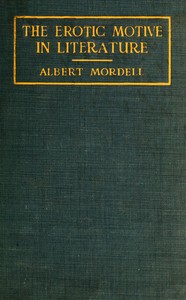
The Erotic Motive in Literature by Albert Mordell
First published in 1919, Albert Mordell's book isn't a novel with a plot in the traditional sense. Instead, it's an argument—a bold, sweeping claim about why writers write and why stories resonate. Mordell's central idea is simple but explosive for its time: he believes that sexual desire, in both its obvious and its deeply hidden forms, is a primary creative force behind literature.
The Story
Mordell doesn't tell a single story; he investigates many. He acts as a critic and psychologist, revisiting the works of giants like Shakespeare, Poe, Dickens, Browning, and the Romantic poets. He sifts through their writing, their biographies, and their letters, looking for clues. He points to characters' motivations, symbolic imagery, and even the authors' own life choices, arguing that what looks like ambition, revenge, or artistic passion on the surface is often powered by a more basic erotic energy. The 'story' here is the journey of his thesis as he applies it across centuries of writing, trying to convince the reader that we've been missing a key piece of the puzzle.
Why You Should Read It
This book is fascinating as a historical document. Reading it today, you get a front-row seat to a moment when psychology was first crashing into literary criticism. Some of Mordell's connections feel sharp and surprisingly modern; others might make you raise an eyebrow or laugh at their bluntness. It's not the final word on the subject—it's more like the provocative starting pistol. I love it because it makes you re-think everything. After reading Mordell, you can't look at a character's 'undefined melancholy' or a writer's 'burning ambition' in quite the same way. It adds a layer of messy, compelling humanity to authors we sometimes put on a dusty pedestal.
Final Verdict
This is a perfect pick for curious readers who love classic literature but always suspected there was more going on. It's for anyone who enjoys a good, argumentative non-fiction book that challenges established ideas. If you like seeing the gears behind great art, or if you're interested in the history of how we interpret stories, you'll find Mordell a gripping, if occasionally outrageous, guide. Just be prepared—it might permanently change how you read.
This historical work is free of copyright protections. Thank you for supporting open literature.
Donald Lee
2 months agoThe layout is perfect for tablet and e-reader devices.
Kimberly Williams
2 years agoA sophisticated analysis that fills a gap in the literature.
John Smith
1 year agoHaving followed this topic for years, I can say that the inclusion of diverse viewpoints strengthens the overall narrative. The insights gained here are worth every minute of reading.
Ashley Williams
10 months agoHaving followed this topic for years, I can say that the case studies and practical examples provided add immense value. A trustworthy resource that I'll keep in my digital library.

Patricia Taylor
10 months agoI started reading this with a critical mind, the level of detail in the second half of the book is truly impressive. A perfect balance of theory and practical advice.