
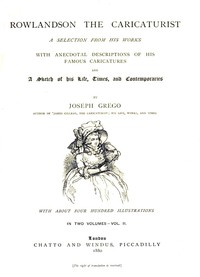
Rowlandson the Caricaturist; a Selection from His Works. Vol. 2 — Inside the Classic

(0 User reviews)   1195
Grego, Joseph, 1843-1908, Rowlandson, Thomas, 1756-1827 [Illustrator] Project Gutenberg 2014 Not confirmed
English wit and humor, Pictorial; Rowlandson, Thomas, 1756-1827 Readers of public-domain and historical texts
Project Gutenberg digital edition en

Edition facts

Words 171,450
Reading time 746 min
Text sections 25

The catalog record for Rowlandson the Caricaturist; a Selection from His Works. Vol. 2 — Inside the Classic provides practical reading context through 171,450 words, 12 hr 26 min estimated reading time, and 25 detected text sections.

The text analysis averages about 14.4 words per sentence, while the detected sections provide another way to judge how the source is divided.

Project Gutenberg metadata also associates the work with “English wit and humor, Pictorial,” connecting these edition facts with the source record’s subject description.

Explore this collection

Compare your next read

These alternatives are selected using recorded categories and estimated reading time.

Search stored excerpts and compare books → Choose by your preferences →

How these choices and excerpts are prepared

Choices use stored catalog measurements. Estimates vary with reading speed. A shared category is a catalog label, not a claim that two books have the same argument or literary quality.

Search reads excerpt text stored with this catalog and links to its associated Gutenberg record. The connection is stored in the site database; this tool does not recheck that every excerpt is word-for-word identical to that external record. Excerpt search does not cover every chapter and does not verify historical publication dates.

Catalog snapshot checked: 2026-09-26. Coverage: 100 public books, 100 available source excerpts.

Joseph Grego's second volume on Thomas Rowlandson catalogs the artist's output from 1800–1825, pairing detailed plate descriptions with biographical context. The excerpts reveal a work more concerned with print-by-print documentation than with sustained analysis of Rowlandson's style or social commentary.
Share
Editorial Edition Score 4.9/5

Calculated from edition completeness, EPUB availability, text structure and catalogue metadata. Not a user rating.

How this score is calculated
  • Description quality20 pts
  • Title & short description10 pts
  • Source metadata20 pts
  • Text length15 pts
  • Chapters / structure15 pts
  • EPUB file integrity20 pts

Total of 100 points, scaled to a 2.5-5.0 range. Editions with an empty description or a missing EPUB file are not scored.

Edition quality

Public-domain source text

Read the source text

The source text is kept in the dedicated reader, separate from this catalogue record and its commentary.

This second volume of Joseph Grego's study of Thomas Rowlandson proceeds year by year from 1800 to 1825, listing each caricature with a descriptive anecdote. The excerpts show a methodical cataloguer at work: Grego supplies the title, date, and often the publisher of each print, then adds a paragraph explaining the scene. For the Doctor Syntax series, he transcribes the preface by the anonymous author William Combe and enumerates every plate in each of the three tours. The result is a reference work that prioritizes inventory over interpretation.

A Year-by-Year Inventory of Prints

The volume's structure is strictly chronological. Each year from 1800 to 1825 gets a section heading, followed by a list of prints. For 1800, Grego records twenty-two items, from Le Brun Travestied to Remarks on a Tour to North and South Wales. The entries are brief: a title, sometimes a note on the subject, and occasionally a cross-reference to a related series. There is no attempt to rank the works by quality or to trace thematic threads across years. The catalog is exhaustive but not evaluative.

The Doctor Syntax Episodes as a Case Study

Grego devotes several pages to the three Doctor Syntax tours, reproducing the preface from the third volume. He notes that the second and third tours were "less successful" than the first, yet he still lists every plate—over sixty in total—with titles such as Doctor Syntax and the Gypsies and Doctor Syntax at a Card Party. The descriptions are purely factual: the plate number, the scene, and occasionally a remark on the popularity of the edition. Grego does not analyze Rowlandson's visual humor or the character's place in the artist's oeuvre.

Biographical Details Embedded in the Catalog

Interspersed with the print lists are brief biographical notes. Grego mentions that Combe wrote the Syntax poems "for his private reasons" while remaining anonymous, and he records that the illustrations were "contributed by Rowlandson, much on his old principle." He also notes the commercial details: the pocket edition of 1823 cost seven shillings per volume, with hand-colored plates, compared to the original guinea. These asides give the reader a sense of the publishing context, but they are never developed into a sustained argument about Rowlandson's career or reputation.

Readers approaching this volume for insight into Rowlandson's artistic development will find instead a meticulous ledger of his output. The value lies in the completeness of the record: every known print from two decades is named and dated. For those researching a specific caricature or tracing the publication history of the Syntax series, Grego's catalog is indispensable. But those seeking critical analysis of Rowlandson's style or social satire will need to look elsewhere.

Flipping through Rowlandson’s crowded, grinning pages, I remembered my grandfather’s chipped copy of The humour of Russia — A Reader’s Guide, which I read one long winter. Both felt less like books and more like attics—every print a drawer, every joke a dust-furred object I could hold and set down. Neither explained itself. They just waited, patient, for a quiet hour.

There are no reviews for this eBook.

0
0 out of 5 (0 User reviews )

Add a Review

Your Rating *
There are no comments for this eBook.

Reader reflection

What was your reading experience?

Capture what you thought, learned, and would like to remember.

Your progress 0 / 10
1

How far have you progressed with this book?

2

Did this book hold your interest?

3

Would you pass this book on to a friend?

4

How easy was the book to follow?

Related eBooks









