
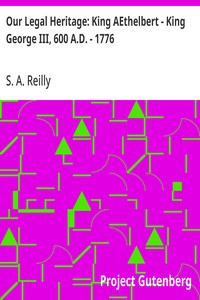
Our Legal Heritage: King AEthelbert - King George III, 600 A.D. - 1776 by Reilly
Let's be honest, a book about 1,176 years of legal history sounds like a cure for insomnia. But S.A. Reilly's Our Legal Heritage is anything but. Reilly doesn't just list laws; he tells the story of how people fought, argued, and sometimes bled to create them.
The Story
The book opens in a world where a person's value was literally measured in shillings. King AEthelbert's laws from 600 AD are startlingly direct: so much for a broken arm, so much for a stolen pig. From there, Reilly guides us through the seismic shifts. We see how the Norman Conquest brought centralized royal justice, how the Magna Carta wasn't just about nobles but planted a seed about limiting power, and how the slow, gritty development of common law—judges building on past decisions—created a system that could adapt. The story culminates in the 18th century, showing how centuries of English legal struggle over rights and representation directly fueled the arguments of the American Founding Fathers.
Why You Should Read It
What makes this book special is how it makes the abstract deeply personal. You stop seeing 'the law' as a monolithic thing and start seeing it as a collection of human solutions to human problems. One minute you're reading about a medieval village solving a brawl, the next you realize you're seeing the early roots of local governance. Reilly has a knack for finding the vivid, sometimes odd, detail that makes a principle stick. You'll never think about your 'rights' the same way after understanding the long, uneven battle to establish them. It provides incredible context for today's legal and political debates, showing that our current arguments are often just the latest chapter in a very old conversation.
Final Verdict
Perfect for anyone curious about why our society is built the way it is. You don't need a law degree; you just need an interest in stories about power, justice, and human ingenuity. History buffs will love the sweep of it, mystery fans will enjoy the 'aha!' moments of connection, and anyone who enjoys a good, foundational story about how we got here will find it fascinating. It's a reminder that the laws we often take for granted are the products of a long and dramatic fight.
This text is dedicated to the public domain. It is now common property for all to enjoy.
Joseph Taylor
9 months agoMy first impression was quite positive because the narrative arc keeps the reader engaged while delivering factual content. This is a solid reference for both beginners and experts.
Barbara Hernandez
6 months agoImpressive quality for a digital edition.
Emily Perez
1 year agoI appreciate how this edition approaches the core problem, the bibliography and references suggest a high level of research and authority. A trustworthy resource that I'll keep in my digital library.
George Garcia
1 year agoExtremely helpful for my current research project.





Ashley Taylor
1 month agoExtremely helpful for my current research project.