
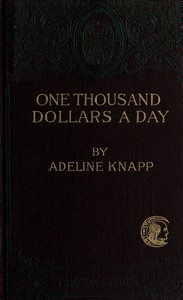
One thousand dollars a day. Studies in practical economics by Adeline Knapp
Published in 1902, Adeline Knapp's One Thousand Dollars a Day. Studies in Practical Economics is a unique blend of social commentary and economic primer. Knapp uses a simple, provocative premise to frame her lessons: what would you do if you were compelled to spend one thousand dollars every day, with strict rules against saving or hoarding it?
The Story
There isn't a traditional plot with characters. Instead, the 'story' is the intellectual journey Knapp takes you on. She starts with that millionaire's dilemma to break down our assumptions about wealth and utility. From there, she branches out into real-world economics. She explains how basic systems work—things like supply and demand, the value of labor, and the true cost of goods—using clear examples from early 20th-century life. She connects big ideas about capital and production to the price of a loaf of bread or a pair of shoes, making abstract concepts feel immediate and personal.
Why You Should Read It
First, it’s fascinating as a historical snapshot. Reading her take on consumer culture and labor over 120 years ago is a trip. But what really got me was how relevant her core questions still are. She’s less concerned with charts and graphs and more with the human side of money: what it means, how it shapes our choices, and what 'value' really is. Her writing is sharp and often witty, which keeps it from feeling dry. You can tell she wanted this book to be for everyone, not just experts. It challenged me to look at my own spending habits and the economy around me with fresh eyes.
Final Verdict
This book is a hidden gem for curious readers who enjoy history, smart nonfiction, or just a great conversation starter. It's perfect for anyone who's ever felt economics was too intimidating or boring, because Knapp strips it down to the stories we tell ourselves about money. If you liked the approachable style of books like Freakonomics or just enjoy time-capsule reads that make you think, you'll get a real kick out of this. It's a short, punchy, and surprisingly modern classic.
This title is part of the public domain archive. Access is open to everyone around the world.
Jennifer Anderson
5 months agoThe digital formatting makes it very easy to navigate.
Robert Johnson
2 months agoIt’s rare to find such a well-structured narrative nowadays, the formatting on mobile devices is surprisingly crisp and clear. A solid investment for anyone's personal development.
William Davis
1 month agoExtremely helpful for my current research project.
Charles Miller
2 years agoThe digital index is well-organized, making research much faster.
Matthew Thompson
3 months agoGiven the current trends in this field, the inclusion of diverse viewpoints strengthens the overall narrative. A refreshing and intellectually stimulating read.