
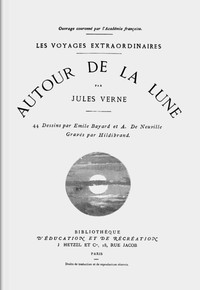
Autour de la lune by Jules Verne
Jules Verne's Autour de la lune is the direct sequel to From the Earth to the Moon, and it starts with a bang—or rather, the aftermath of one. Our three adventurers are already sealed inside their aluminum projectile, fired from a gigantic cannon in Florida. There's no turning back.
The Story
The book is basically the mission log of the first (fictional) crewed trip to the moon. Barbicane, Nicholl, and Ardan have to deal with zero gravity, manage their air supply, and make careful astronomical observations. The mood shifts from wonder to dread when a small meteoroid strikes their craft. This collision alters their trajectory just enough that instead of landing on the moon, they are captured by its gravity and sent into a looping orbit around it. The mission becomes a frantic fight for survival as they calculate if they have enough speed to break free from the moon's pull and fall back to Earth, or if they are doomed to circle it forever as a man-made moon. The tension is fantastic, balanced by the crew's lively debates and Ardan's unwavering good cheer.
Why You Should Read It
What amazed me most wasn't the adventure (though it's gripping), but Verne's brain. Writing in the 1860s, he grapples with real physics: the silence of space, the effects of weightlessness, orbital mechanics, and even the idea of a 'spacewalk.' He gets so much eerily right. But the heart of the book is the trio inside the capsule. Barbicane is all logic, Nicholl is all doubt, and Ardan is all passionate curiosity. Their dynamic is what keeps the story from feeling like a dry science lecture. You're right there with them, peering out the portholes at the lunar landscape, sharing their terror and their awe.
Final Verdict
This is a must-read for classic sci-fi fans and anyone who loves a grounded adventure. It's perfect for readers who enjoy 'hard' science fiction where the rules of the universe matter, but who also want characters with personality. If you've ever looked up at the moon and imagined the journey, Verne's vision—part scientific prediction, part thrilling tale of human ingenuity—is still incredibly satisfying. Just be ready to read it in one sitting; you'll need to know how they get home.
You are viewing a work that belongs to the global public domain. It is available for public use and education.
Michelle Johnson
11 months agoHonestly, the emotional weight of the story is balanced perfectly. I couldn't put it down.
Deborah Moore
7 months agoCitation worthy content.
Michael Martinez
1 year agoI started reading out of curiosity and the content flows smoothly from one chapter to the next. Absolutely essential reading.






Paul Martinez
3 months agoHaving explored several resources on this, I find that the case studies and practical examples provided add immense value. A mandatory read for anyone in this industry.