
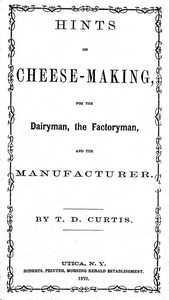
Hints on cheese-making, for the dairyman, the factoryman, and the manufacturer
Forget everything you think you know about dry technical manuals. Hints on Cheese-Making is a direct, no-nonsense conversation from 1881, where the stakes were incredibly high. Author Thomas Day Curtis isn't writing for hobbyists; he's talking to people whose lives depend on the success of their dairy.
The Story
There isn't a plot with characters, but there is a clear mission: defeat inconsistency and failure. Curtis walks the reader through the entire cheese-making process, from selecting the right milk and managing the cow's diet, through the precise steps of renneting, cutting the curd, pressing, and curing. Each chapter tackles a potential point of failure. He explains why cheese might turn out bitter, sour, or crumbly, and gives practical, actionable fixes. The 'story' is the journey from raw, unpredictable milk to a perfect, marketable wheel of cheese, and all the pitfalls that can happen along the way.
Why You Should Read It
This book completely changed how I look at the food in my fridge. It’s humbling. Curtis's voice is firm and authoritative, but you can sense his genuine desire to help. He’s trying to lift the entire industry by sharing knowledge. Reading his precise instructions—like testing rennet strength with a drop on your thumbnail, or judging the curd's readiness by feel—makes you appreciate the immense skill and intuition these tradespeople needed. It's hands-on science before it was called food science. You get a real sense of the community, too, as he warns against shady practices that give dairies a bad name. It’s a masterclass in craftsmanship and ethics.
Final Verdict
This is a niche read, but a profoundly cool one. It's perfect for history lovers who enjoy seeing how everyday things were really done, for foodies obsessed with craft and origin, or for anyone in agriculture who might get a kick from the foundational texts of their field. You won't come away ready to make cheddar in your basement (though you could try!), but you will gain a deep respect for the art and immense effort behind a staple food. Think of it as a primary source document that tastes like sharp, well-aged knowledge.
This historical work is free of copyright protections. It serves as a testament to our shared literary heritage.
Thomas Martin
9 months agoIt’s refreshing to see such a high standard of digital publishing.
George Brown
3 months agoThe layout of the digital version made it easy to start immediately, the quality of the diagrams and illustrations (if applicable) is top-notch. Truly a masterpiece of digital educational material.
Donald Allen
4 months agoIf you enjoy this genre, it challenges the reader's perspective in an intellectual way. I would gladly recommend this title.







Karen Davis
11 months agoGiven the current trends in this field, the structural organization allows for quick referencing of key points. The insights gained here are worth every minute of reading.