
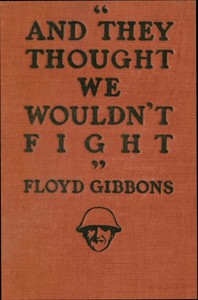
"And they thought we wouldn't fight" by Floyd Phillips Gibbons
Floyd Phillips Gibbons wasn't just a reporter; he was a participant. As the Chicago Tribune's war correspondent, he landed in France with some of the first American soldiers in 1917. His book is built from his own vivid dispatches and experiences.
The Story
The book follows the American journey from eager arrival to brutal combat. Gibbons takes us from the docks of France, where the raw troops are organized, straight to the front lines. He doesn't shy away from the grim details—the constant mud, the deafening artillery barrages, the grim reality of trench warfare. He was famously at the Battle of Belleau Wood in 1918, where U.S. Marines fought a bloody and pivotal battle, and his reporting from that hellscape is central to the narrative. The 'story' is really the transformation of an idea—the untested American force—into a hardened, battle-proven army, told by a man who was shot and nearly killed while covering it.
Why You Should Read It
You should read this because it has no filter. History books summarize and analyze; Gibbons makes you feel the confusion of a night march, the adrenaline of an attack, and the exhaustion afterward. His writing is direct and powerful. He admired the courage of the common soldier, and that respect shines through on every page. Reading this is like finding a box of intensely personal letters from the front. It strips away the decades of legend and gives you the unvarnished truth of courage and sacrifice. It’s a powerful reminder that history is made by individuals, not just armies.
Final Verdict
This is a must-read for anyone interested in real, gritty military history or firsthand accounts of war. It's perfect for readers who loved books like 'All Quiet on the Western Front' but want the non-fiction, American perspective. If you're a fan of narrative history that puts you right in the middle of the action, Gibbons is your guide. Fair warning: it's not a light read. It's honest, often harsh, and incredibly moving. But if you want to understand the true cost and character of America's entry into the Great War, there's hardly a better place to start.
This text is dedicated to the public domain. You do not need permission to reproduce this work.
Oliver Ramirez
11 months agoSimply put, the content flows smoothly from one chapter to the next. Thanks for sharing this review.
Karen Gonzalez
1 year agoA bit long but worth it.
Carol Ramirez
9 months agoThis is one of those stories where the clarity of the writing makes this accessible. Thanks for sharing this review.