About 96 minutes
If Winter Don't A.B.C.D.E.F. Notsomuchinson — A Reader’s Guide
Adventure Picaresque Fiction
21,899 recorded words. 23 minutes difference from this book's estimate.
View Gutenberg source #27375
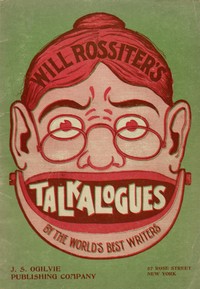
Before opening Will Rossiter's Original Talkalogues by American Jokers — Themes and Context, the edition data offers a quick orientation: 27,236 words, 1 hr 59 min estimated reading time, and 17 detected text sections.
The text analysis averages about 14.5 words per sentence, while the detected sections provide another way to judge how the source is divided.
Project Gutenberg metadata also associates the work with “American wit and humor,” connecting these edition facts with the source record’s subject description.
Explore this collection
These alternatives are selected using recorded categories and estimated reading time.
About 96 minutes
Adventure Picaresque Fiction
21,899 recorded words. 23 minutes difference from this book's estimate.
View Gutenberg source #27375About 156 minutes
Adventure Picaresque Fiction
35,832 recorded words. 37 minutes difference from this book's estimate.
View Gutenberg source #26281About 72 minutes
Adventure Picaresque Fiction
16,369 recorded words. 47 minutes difference from this book's estimate.
View Gutenberg source #35874Search stored excerpts and compare books → Choose by your preferences →
Choices use stored catalog measurements. Estimates vary with reading speed. A shared category is a catalog label, not a claim that two books have the same argument or literary quality.
Search reads excerpt text stored with this catalog and links to its associated Gutenberg record. The connection is stored in the site database; this tool does not recheck that every excerpt is word-for-word identical to that external record. Excerpt search does not cover every chapter and does not verify historical publication dates.
Catalog snapshot checked: 2026-09-26. Coverage: 100 public books, 100 available source excerpts.
Calculated from edition completeness, EPUB availability, text structure and catalogue metadata. Not a user rating.
Total of 100 points, scaled to a 2.5-5.0 range. Editions with an empty description or a missing EPUB file are not scored.
Public-domain source text
The source text is kept in the dedicated reader, separate from this catalogue record and its commentary.
Will Rossiter's Original Talkalogues by American Jokers (1903) presents a sequence of comic monologues and sketches attributed to vaudeville figures like E. P. Moran, Harry L. Newton, and Joseph Horrigan. The collection's title—a portmanteau of 'talk' and 'catalogue'—signals its structure: a series of short, standalone pieces that mimic oral performance. The opening monologue immediately establishes a pattern of absurd mishaps, as a narrator describes a marital argument over automobile driving that ends with both spouses 'falling out' of the vehicle. This blend of domestic friction and mechanical malfunction recurs throughout, often framed as a rapid-fire anecdote delivered in a colloquial, breathless voice.
The automobile appears repeatedly as a catalyst for comic chaos. In the opening 'Talkalogue,' the narrator and his wife argue over who is the better chauffeur, neglect the reins, and crash when the car 'shied at a piece of paper.' The humor derives from the incongruity of applying horse-and-buggy terminology ('lines,' 'shied') to a modern machine, and from the physical comedy of the wife grabbing the narrator's hair. This motif is not merely a one-off gag; it reflects a broader pattern of technology disrupting domestic harmony. Later pieces, such as 'The Man from Squashopolis,' likely extend this theme, though the excerpts are incomplete. The automobile becomes a prop for exploring marital power struggles, with the vehicle's autonomy mirroring the characters' loss of control.
The collection relies heavily on dialect and regional stereotypes to generate humor. Titles like 'The Man from Squashopolis' and 'Happenings in KeroseneLampville' signal a fascination with rural or small-town characters, often rendered in exaggerated vernacular. In the opening monologue, the narrator's voice is marked by colloquialisms ('Well, well! here we are again!') and a breathless, run-on syntax that mimics oral storytelling. Other contributors, such as Harry L. Newton, contribute pieces like 'The Pacific Slope' and 'Rapid Fire,' which likely deploy Western or urban dialects. The effect is a mosaic of American speech patterns, though the excerpts do not reveal whether the dialects are used for satire or simple caricature. The inclusion of 'Li Hung Chang's Joke' suggests an attempt at ethnic humor, but the text is not provided.
The 'talkalogue' format mirrors vaudeville monologues: a single performer addresses the audience directly, building to a punchline or a series of quick jokes. The collection's structure reinforces this, with sections like 'Rapid Fire' (by Harry L. Newton) and 'Fifteen Minutes with a Playwright' suggesting timed routines. The pieces are short—often a page or two—and rely on abrupt transitions and non-sequiturs. For example, the opening monologue jumps from the automobile crash to a pun on 'falling out' (both physical and relational). This rapid pacing is a deliberate stylistic choice, prioritizing immediate laughs over narrative coherence. The publisher's note, a four-line rhyme urging readers to 'pass it on to friend or brother,' frames the book as disposable entertainment, meant to be consumed quickly and shared.
The edition is saturated with advertisements for products like Murine Eye Remedy and Ogilvie's joke books, which intrude on the text and reflect the original 1903 publication's commercial nature. These ads are not mere appendages; they are woven into the reading experience, with the Murine ad appearing immediately after the title page and the back matter listing dozens of similar joke books. This context shapes the talkalogues themselves: they are commodities designed to sell both the book and the products advertised within it. The humor often targets consumer culture—the automobile, the eye remedy—but the line between joke and advertisement blurs. The 'Publisher's Note' explicitly encourages sharing, treating the book as a viral marketing tool. Understanding this commercial framework is essential to appreciating the talkalogues' function as ephemeral, market-driven entertainment.
Readers approaching Original Talkalogues should expect a fragmented, performance-driven text that rewards attention to voice and timing rather than plot. The collection's value lies in its snapshot of early 20th-century American humor—its preoccupations with technology, regional identity, and the rhythms of vaudeville. Because the excerpts are incomplete, the full range of contributors and topics remains unclear, but the recurring motifs of automobiles and domestic strife offer a coherent thread. Treat each talkalogue as a standalone routine, and note how the advertisements frame the humor as a commercial product.
I was flipping through the old talkalogues, past the automobile jokes and the small-town squabbles, and something about their hurried, performative cheer set me to remembering another shelf. It odd how a book of stage sketches leaves you thinking of quiet reading notes. A different tempo, a private sort of companion, like a whisper against all that hollering. That led me to Three Men and a Maid — Reading Notes, which felt just as heartfelt, but so much more hushed.
Create a short personal record of your experience with this book.




![Cover of The three sisters [Night watches, Part 6.] — A Closer Reading](https://ujayu.com/storage/media/covers/pg12156.jpg)




