
The Old Soak, and Hail And Farewell — Context and Discussion

(0 User reviews)   420
Marquis, Don, 1878-1937, Patterson, Sterling [Illustrator] Project Gutenberg 2016 Not confirmed
American wit and humor; Humorous poetry, American Readers of public-domain and historical texts
Project Gutenberg digital edition en

Edition facts

Words 26,541
Reading time 116 min
Text sections 4

The Old Soak, and Hail And Farewell — Context and Discussion can be approached with a clearer sense of reading commitment from its source measurements: 26,541 words, 1 hr 56 min estimated reading time, and 4 detected text sections.

The text analysis averages about 23.2 words per sentence, while the detected sections provide another way to judge how the source is divided.

Project Gutenberg metadata also associates the work with “American wit and humor,” connecting these edition facts with the source record’s subject description.

Explore this collection

Compare your next read

These alternatives are selected using recorded categories and estimated reading time.

Search stored excerpts and compare books → Choose by your preferences →

How these choices and excerpts are prepared

Choices use stored catalog measurements. Estimates vary with reading speed. A shared category is a catalog label, not a claim that two books have the same argument or literary quality.

Search reads excerpt text stored with this catalog and links to its associated Gutenberg record. The connection is stored in the site database; this tool does not recheck that every excerpt is word-for-word identical to that external record. Excerpt search does not cover every chapter and does not verify historical publication dates.

Catalog snapshot checked: 2026-09-26. Coverage: 100 public books, 100 available source excerpts.

Don Marquis's 1921 collection pairs a comic monologue by a Prohibition-era tippler with nostalgic poems. The Old Soak's rambling, self-justifying voice turns barroom sentiment into a satirical argument for liquor, while the verse section mourns lost taverns and drinking culture.
Share
Editorial Edition Score 4.6/5

Calculated from edition completeness, EPUB availability, text structure and catalogue metadata. Not a user rating.

How this score is calculated
  • Description quality20 pts
  • Title & short description10 pts
  • Source metadata20 pts
  • Text length15 pts
  • Chapters / structure15 pts
  • EPUB file integrity20 pts

Total of 100 points, scaled to a 2.5-5.0 range. Editions with an empty description or a missing EPUB file are not scored.

Edition quality

Public-domain source text

Read the source text

The source text is kept in the dedicated reader, separate from this catalogue record and its commentary.

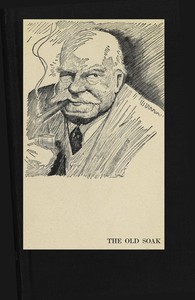
The Old Soak speaks in a voice that is at once folksy and cunning, a blend of rueful humor and pointed argument. From the opening lines, where he dismisses hope because it "don't gurgle none when you pour it out of a bottle," Marquis establishes a character who measures everything against the tangible pleasure of drink. The monologue is structured as a series of conversational rants, each chapter heading a promise of more "history" that never quite arrives as straight narrative. Instead, the Soak circles back to the same themes—the lost sociability of barrooms, the hypocrisy of prohibitionists, the sentimental education provided by drinking songs—building a case that is both absurd and oddly persuasive. The accompanying poems, grouped under "Hail and Farewell," shift to a more lyrical register, but the preoccupation remains the same: the texture of a vanished drinking life, recalled in tavern booths and brass railings.

The Soak's Rhetorical Strategy

The Old Soak does not argue for drink on principle; he argues through anecdote and false equivalence. When he claims that barroom songs about home and mother made him a better man, he is not being ironic—or rather, the irony lies in the sincerity. He presents the loss of these songs as a civic tragedy: "Nobody is never going to think as much of home and mother as they used to." The logic is deliberately flawed, and Marquis lets the reader see the gap between cause and effect. The Soak's voice is full of verbal tics—"Yes, sir; yes, sir!"—that mimic oral storytelling, and his digressions (like the plan to get his son-in-law a job as a "revenooer") undercut his own moralizing. The humor comes from watching a man build a castle of self-justification on a foundation of bourbon.

Sentiment as Satire

Marquis weaponizes sentimentality. The Soak's fondest memories are of maudlin drinking songs: "All them songs about home and mother and to treat her right now that her hair had turned gray." He claims these songs stirred his "softer emotions" and made him want to write letters home. But the satire cuts both ways: the Soak is genuinely moved, yet his solution to every problem—from hard-heartedness to mortgage payments—is more bar time. The poems in "Hail and Farewell" are less ironic, but they share the same emotional register. Lines like "I'd rather have Despair combined with a case of Bourbon liquor" turn a punchline into a credo. The effect is a kind of double vision: we laugh at the Soak's logic, but the loss he describes—of community, of ritual, of a place to be soft-hearted—feels real.

The Vanished Barroom as Setting

The barroom in these pages is never described in detail; it exists as a set of sounds and feelings. The Soak recalls "the right sort of a place" where men sang together, and the poems evoke "an old-time tavern booth" and "the old brass railing." Specificity is deliberately vague—the barroom is a type, not a location. What matters is the atmosphere: the clink of glasses, the camaraderie, the permission to feel. Marquis uses this vagueness to make the barroom stand for a whole lost social world. The Soak's fear that "the younger generations of posterity" will grow up "hard hearted" without these rituals is comic in its exaggeration, but it points to a real anxiety about social change. The setting is less a place than a memory of a place, and the book's tension lies in how seriously we take that memory.

Readers will find that the two halves of this volume speak to each other in unexpected ways. The prose monologue and the poems are not separate works but complementary modes: one expansive and comic, the other compressed and elegiac. Pay attention to how the Soak's voice shifts when he talks about his son-in-law the revenuer—a detail that hints at family dynamics beneath the political argument. The book rewards a slow reading, letting the repetitions and contradictions build into a portrait of a man talking himself into a corner.

Reading Old Soak’s voice brought back my grandfather’s late-afternoon rambles, half apology, half defiance. That same haze of nostalgia and self-justification hung over Leacock’s wartime sketches in Frenzied Fiction — Background and Themes, where the absurdity felt less like satire than a held breath. Both books catch a world leaning on its own fading, and I found myself nodding, quietly, at that familiar ache.

There are no reviews for this eBook.

0
0 out of 5 (0 User reviews )

Add a Review

Your Rating *
There are no comments for this eBook.

Reader reflection

What was your reading experience?

Capture what you thought, learned, and would like to remember.

Your progress 0 / 10
1

Which reading stage best describes you?

2

How did the book work for you overall?

3

Would you recommend this book to another reader?

4

How easy was the book to follow?

Related eBooks








