About 251 minutes
Psmith in the City — Key Ideas to Explore
Historical Psychological Social Fiction
57,517 recorded words. 10 minutes difference from this book's estimate.
View Gutenberg source #6753
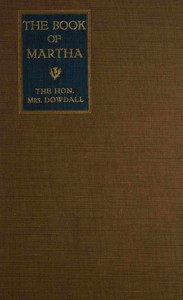
The catalog record for The book of Martha — Edition Insights provides practical reading context through 55,281 words, 4 hr 1 min estimated reading time, and 29 detected text sections.
The text analysis averages about 16.8 words per sentence, while the detected sections provide another way to judge how the source is divided.
Project Gutenberg metadata also associates the work with “English wit and humor,” connecting these edition facts with the source record’s subject description.
Explore this collection
These alternatives are selected using recorded categories and estimated reading time.
About 251 minutes
Historical Psychological Social Fiction
57,517 recorded words. 10 minutes difference from this book's estimate.
View Gutenberg source #6753About 231 minutes
Historical Psychological Social Fiction
53,063 recorded words. 10 minutes difference from this book's estimate.
View Gutenberg source #8457About 226 minutes
Historical Psychological Social Fiction
51,943 recorded words. 15 minutes difference from this book's estimate.
View Gutenberg source #54409Search stored excerpts and compare books → Choose by your preferences →
Choices use stored catalog measurements. Estimates vary with reading speed. A shared category is a catalog label, not a claim that two books have the same argument or literary quality.
Search reads excerpt text stored with this catalog and links to its associated Gutenberg record. The connection is stored in the site database; this tool does not recheck that every excerpt is word-for-word identical to that external record. Excerpt search does not cover every chapter and does not verify historical publication dates.
Catalog snapshot checked: 2026-09-26. Coverage: 100 public books, 100 available source excerpts.
Calculated from edition completeness, EPUB availability, text structure and catalogue metadata. Not a user rating.
Total of 100 points, scaled to a 2.5-5.0 range. Editions with an empty description or a missing EPUB file are not scored.
Public-domain source text
The source text is kept in the dedicated reader, separate from this catalogue record and its commentary.
The narrator, Martha, opens by declaring that the book ought to have been called Ruth, for Ruth has shaped her life for thirty years. Yet in a moment of mutiny, she claims the title for herself: “The book at least shall be mine.” This tension between Martha’s desire for autonomy and the daily intrusions of household management sets the tone for a series of comic vignettes. The first chapter establishes a voice that is wry, self-deprecating, and sharply observant, as Martha describes her ideal of a simpler married life and the reality of servants who seem to multiply and fill every room.
Martha’s narration is distinctive for its blend of irony and exasperation. She describes her friend Elizabeth Tique’s house, where servants in “spotted cotton” seem to appear everywhere, and her own bedroom is invaded by two maids simultaneously. The humor lies in the accumulation of small domestic tyrannies: the cook who rules the kitchen, the housemaid who rearranges furniture, the tradesmen who overcharge. Martha’s voice is that of a woman who is both victim and amused observer, and her asides—such as comparing her mental state to “drunken men see spiders”—give the prose a lively, conversational quality.
Ruth is a constant offstage presence. Martha explains that Ruth has taken possession of her house, tradespeople, children, and leisure. The book’s structure, with chapters titled “The Cook,” “The Housemaid,” “Tradesmen,” and so on, suggests that each chapter is a battle in a long war against domestic chaos—and that Ruth, though absent, is the general on the other side. Martha’s decision to name the book after herself is a small rebellion, but the reader senses that Ruth’s influence pervades every anecdote. The excerpts do not reveal whether Ruth ever appears in person, but her ghost haunts the margins.
The excerpts include two extended comic sequences: the house-moving episode and the encounter with the house-agent. In the moving scene, a foreman promises to move only what is marked “not to go,” yet takes everything, including a potato labeled “not to go” that later sprouts under a bed. The agent’s visit introduces “Mrs. Simpson,” a persona Martha involuntarily adopts when dealing with condescending men. She describes becoming Mrs. Simpson in an advertisement, running about a tennis lawn with “young men with Arrow collars.” These set pieces are not just jokes; they reveal Martha’s frustration with the roles society forces on her, and her ability to laugh at herself.
The table of contents lists twenty-three chapters, each focusing on a different domestic sphere: the cook, the housemaid, tradesmen, the dinner party, children, the schoolroom, husbands, Christmas, and so on. This episodic structure means the book can be read in short bursts, each chapter a self-contained anecdote. The excerpts suggest that the humor builds cumulatively, as Martha’s complaints become a kind of litany. The reader should expect repetition of themes—servants, money, social expectations—but also a growing sense of Martha’s character as she navigates each new challenge. The final chapters, such as “Genius” and “Charity,” hint at broader social commentary beyond the home.
The Book of Martha rewards a reader who enjoys dry wit and domestic satire. Pay attention to the recurring motifs: the battle over household space, the tyranny of well-meaning friends, and the small victories of self-assertion. Martha’s voice is the thread that ties the episodes together, and her occasional moments of mutiny—like claiming the title—give the book its emotional core. Read it as a series of comic essays rather than a novel, and you will find a sharp, affectionate portrait of early twentieth-century domestic life.
Reading Martha’s fuss over serving proper puddings, I thought of my own grandmother’s kitchen—her pride, her quiet fury. It reminded me oddly of A Learned Dissertation on Dumpling (1726) [and] Pudding and Dumpling Burnt to Pot. Or a Compleat Key to the Dissertation on Dumpling (1727) — Key Ideas to Explore, that old joke about trivial things taken so seriously. A kind of comfort, really, that domestic fussing never changes.
A brief reflection can help important ideas stay with you longer.








![Cover of A Learned Dissertation on Dumpling (1726) [and] Pudding and Dumpling Burnt to Pot. Or a Compleat Key to the Dissertation on Dumpling (1727) — Key Ideas to Explore](https://ujayu.com/storage/media/covers/pg28105.jpg)
