About 542 minutes
Froth: A Novel — Edition Insights
Historical Psychological Social Fiction
124,602 recorded words. 55 minutes difference from this book's estimate.
View Gutenberg source #38411
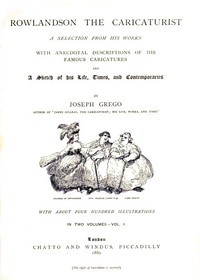
The source record for Rowlandson the Caricaturist; a Selection from His Works. Vol. 1 — Text and Context measures this digital text at 137,224 words, 9 hr 57 min estimated reading time, and 21 detected text sections.
The text analysis averages about 18.6 words per sentence, while the detected sections provide another way to judge how the source is divided.
Project Gutenberg metadata also associates the work with “English wit and humor, Pictorial,” connecting these edition facts with the source record’s subject description.
Explore this collection
These alternatives are selected using recorded categories and estimated reading time.
About 542 minutes
Historical Psychological Social Fiction
124,602 recorded words. 55 minutes difference from this book's estimate.
View Gutenberg source #38411About 464 minutes
Historical Psychological Social Fiction
106,641 recorded words. 133 minutes difference from this book's estimate.
View Gutenberg source #69530About 379 minutes
Historical Psychological Social Fiction
87,003 recorded words. 218 minutes difference from this book's estimate.
View Gutenberg source #14815Search stored excerpts and compare books → Choose by your preferences →
Choices use stored catalog measurements. Estimates vary with reading speed. A shared category is a catalog label, not a claim that two books have the same argument or literary quality.
Search reads excerpt text stored with this catalog and links to its associated Gutenberg record. The connection is stored in the site database; this tool does not recheck that every excerpt is word-for-word identical to that external record. Excerpt search does not cover every chapter and does not verify historical publication dates.
Catalog snapshot checked: 2026-09-26. Coverage: 100 public books, 100 available source excerpts.
Calculated from edition completeness, EPUB availability, text structure and catalogue metadata. Not a user rating.
Total of 100 points, scaled to a 2.5-5.0 range. Editions with an empty description or a missing EPUB file are not scored.
Public-domain source text
The source text is kept in the dedicated reader, separate from this catalogue record and its commentary.
Joseph Grego's 1880 study of Thomas Rowlandson opens with a preface that positions the work as a guide for both connoisseurs and the uninitiated. Grego acknowledges that to many, Rowlandson's name suggests mere 'oddity' or vulgarity, and he volunteers as a 'pioneer' through the artist's 'devious and eccentric intricacies.' The volume's structure—a selection of prints with anecdotal descriptions—reflects this dual audience, offering detailed commentary on individual caricatures while weaving in a broader sketch of Rowlandson's life, times, and contemporaries.
The Project Gutenberg record classifies this work under 'English wit and humor, Pictorial' and 'Historical, Psychological & Social Fiction,' but the excerpts reveal a different emphasis. Grego's text is not fiction but a biographical and critical survey, dense with historical references—parliamentary debates, royal visits, and figures like the Polish dwarf Count Boruwloski. The 'Psychological' tag is misleading; Grego offers no interior analysis of Rowlandson, focusing instead on the prints' satirical targets and the circumstances of their publication. Readers expecting a novel will find instead a Victorian art-historical compilation, complete with footnotes and a preface defending the artist's propriety.
The excerpts describe several prints from March and April 1786, revealing Rowlandson's methods. In Luxury — Misery, he contrasts a breakfast in bed with shipwreck victims, using stark juxtaposition. The Morning Dram targets a lady's drinking habit, with a French hairdresser as a detail. The Polish Dwarf plays on scale, placing the two-foot-four-inch Count Boruwloski before oversized harem beauties and guards. Grego notes that this print was 'studied from the life,' indicating Rowlandson's observational practice. The descriptions emphasize the artist's ability to condense social commentary into single scenes, often with a theatrical sense of contrast.
Each print entry includes the publisher and address—E. Jackson, J. Phillips, H. Brookes—suggesting a network of London print sellers. Grego also embeds political context: the 'leathern ordnance' scheme by the Duke of Richmond, mocked in one print, is explained with reference to parliamentary 'vexed discussion' and 'political apostasy.' This shows that Rowlandson's satire was not timeless but tied to specific controversies. Grego's commentary thus functions as a historical gloss, decoding references that would have been immediate to 1780s viewers but obscure to later readers. The volume becomes as much a record of late Georgian public life as of the artist himself.
Grego's volume rewards readers who approach it as a period piece—a Victorian editor's attempt to canonize a Georgian satirist. The descriptions are more valuable for the historical details they preserve than for aesthetic judgment. Readers interested in Rowlandson's technique should compare Grego's verbal accounts with the actual prints, many of which are available through the Internet Archive source cited in the text.
Sometimes, turning the heavy pages of Grego's Rowlandson, I felt the artist's sharp eye lingering on ordinary, slightly absurd human moments. It reminded me of a quieter, more patient voice I once found in Mr. Scraggs — Reading Companion, where the humor breathes rather than laughs. Both seem to notice the same small follies, but with different temperatures—one boiling, one warm to the touch.
Capture what you thought, learned, and would like to remember.








![Cover of A Learned Dissertation on Dumpling (1726) [and] Pudding and Dumpling Burnt to Pot. Or a Compleat Key to the Dissertation on Dumpling (1727) — Key Ideas to Explore](https://ujayu.com/storage/media/covers/pg28105.jpg)
