About 57 minutes
The Complete Works of Artemus Ward — Part 3: Stories and Romances — Story, Setting & Ideas
Fantasy Juvenile Worlds
12,924 recorded words. 28 minutes difference from this book's estimate.
View Gutenberg source #3273
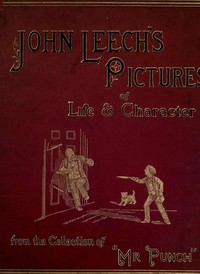
The source record for John Leech's Pictures of Life and Character, Volume 1 (of 3) From the Collection of "Mr. Punch" — Story, Setting & Ideas measures this digital text at 6,562 words, 29 min estimated reading time, and 10 detected text sections.
The text analysis averages about 9.5 words per sentence, while the detected sections provide another way to judge how the source is divided.
Project Gutenberg metadata also associates the work with “English wit and humor, Pictorial,” connecting these edition facts with the source record’s subject description.
Explore this collection
These alternatives are selected using recorded categories and estimated reading time.
About 57 minutes
Fantasy Juvenile Worlds
12,924 recorded words. 28 minutes difference from this book's estimate.
View Gutenberg source #3273About 67 minutes
Fantasy Juvenile Worlds
15,217 recorded words. 38 minutes difference from this book's estimate.
View Gutenberg source #78197About 69 minutes
Fantasy Juvenile Worlds
15,740 recorded words. 40 minutes difference from this book's estimate.
View Gutenberg source #25041Search stored excerpts and compare books → Choose by your preferences →
Choices use stored catalog measurements. Estimates vary with reading speed. A shared category is a catalog label, not a claim that two books have the same argument or literary quality.
Search reads excerpt text stored with this catalog and links to its associated Gutenberg record. The connection is stored in the site database; this tool does not recheck that every excerpt is word-for-word identical to that external record. Excerpt search does not cover every chapter and does not verify historical publication dates.
Catalog snapshot checked: 2026-09-26. Coverage: 100 public books, 100 available source excerpts.
Calculated from edition completeness, EPUB availability, text structure and catalogue metadata. Not a user rating.
Total of 100 points, scaled to a 2.5-5.0 range. Editions with an empty description or a missing EPUB file are not scored.
Public-domain source text
The source text is kept in the dedicated reader, separate from this catalogue record and its commentary.
John Leech's Pictures of Life and Character is a collection of cartoons originally published in Punch between 1842 and 1863, here presented as the first of three volumes. The only text in this digital edition is the captions drawn by Leech as part of each image—a fact the transcriber notes, urging readers to view the original-size images to appreciate the fine details and nuances of expression. The index lists over 200 entries, from 'Advantages of the new Postal arrangements' to 'Aged Juvenile,' offering a panorama of Victorian society through Leech's gently satirical eye.
Because the images themselves are absent from the text file, the captions become the primary narrative. They range from single words—'Alarming' appears twice, in 1850 and 1858—to short phrases like 'All is fair in Love, &c.' (1855) or 'Romance and Reality' (1852). These captions often hint at a story: 'Anxious Moment' (1853), 'Startling Effect of the "Gold Diggings"' (1852). The brevity forces the reader to imagine the scene, making the captions a kind of minimalist poetry. Leech's titles also reveal recurring themes: the seaside, sport, domestic life, and social pretension. 'Sea-side Literature for Young Ladies' (1849) and 'The Sea-side Hat' (1854) suggest a running commentary on leisure and fashion.
Several captions point to stock figures Leech returned to: 'The Rising Generation' appears in 1846, 1847, and 1851, suggesting a series on children or youth. 'Sporting Gent practising for the Season' (1847) and 'Sporting Extraordinary' (1852) indicate a fascination with the sporting world. 'Servantgalism' (1853) and 'Social Struggles' (1852) hint at class dynamics. The repetition of 'Alarming' across years suggests a running joke about exaggerated reactions. Without the images, we can only infer the visual gags, but the captions alone create a taxonomy of Victorian types: the anxious, the pretentious, the sporting, the seaside holidaymaker.
The index reveals clusters of related captions within single years. In 1852, for instance, we find 'Advice Gratis,' 'Affair of Importance,' 'An Exclusive,' 'Romance and Reality,' 'Social Struggles,' and 'Sporting Extraordinary'—a mix of social commentary and humor. 1853 includes 'Alarming,' 'Anxious Moment,' 'Remonstrance,' 'Servantgalism,' and 'Son and Heir,' suggesting a focus on domestic and social tensions. The years 1845-1847 show many sporting and seaside themes. This clustering implies that Leech worked in thematic bursts, responding to seasonal events or ongoing social debates. The captions 'Agricultural Distress' (1851) and 'Another Bit from the Mining Districts' (1854) show engagement with economic issues, while 'Religion à la Mode' (1850) and 'Shakespeare a little altered' (1845) indicate cultural satire.
Readers should approach this volume as a visual archive: the captions are clues to lost images. To fully appreciate Leech's art, view the original-size scans linked in the digital edition. The index serves as a map of Victorian preoccupations, from the trivial to the political. Let the captions spark your imagination of the scenes Leech drew.
Flipping through these Leech plates, I remembered my grandfather chuckling over a tattered copy of The Humors of Falconbridge A Collection of Humorous and Every Day Scenes — Story, Setting & Ideas one rainy Sunday. Both books catch that silly, affectionate glance at ordinary folk—the stiff walk of an annoyed tradesman, the pomp of a dubious tenant—without cruelty, just the warmth of shared recognition, as if smiling quietly at a neighbor we’ve always known.
Create a short personal record of your experience with this book.









