About 317 minutes
Scotch Wit and Humor — Key Ideas to Explore
Adventure Picaresque Fiction
72,796 recorded words. 6 minutes difference from this book's estimate.
View Gutenberg source #41732
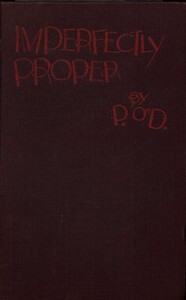
Before opening Imperfectly Proper — A Reader’s Guide, the edition data offers a quick orientation: 71,494 words, 5 hr 11 min estimated reading time, and 9 detected text sections.
The text analysis averages about 18.8 words per sentence, while the detected sections provide another way to judge how the source is divided.
Project Gutenberg metadata also associates the work with “Canadian wit and humor,” connecting these edition facts with the source record’s subject description.
Explore this collection
These alternatives are selected using recorded categories and estimated reading time.
About 317 minutes
Adventure Picaresque Fiction
72,796 recorded words. 6 minutes difference from this book's estimate.
View Gutenberg source #41732About 302 minutes
Adventure Picaresque Fiction
69,280 recorded words. 9 minutes difference from this book's estimate.
View Gutenberg source #49863About 324 minutes
Adventure Picaresque Fiction
74,393 recorded words. 13 minutes difference from this book's estimate.
View Gutenberg source #65520Search stored excerpts and compare books → Choose by your preferences →
Choices use stored catalog measurements. Estimates vary with reading speed. A shared category is a catalog label, not a claim that two books have the same argument or literary quality.
Search reads excerpt text stored with this catalog and links to its associated Gutenberg record. The connection is stored in the site database; this tool does not recheck that every excerpt is word-for-word identical to that external record. Excerpt search does not cover every chapter and does not verify historical publication dates.
Catalog snapshot checked: 2026-09-26. Coverage: 100 public books, 100 available source excerpts.
Calculated from edition completeness, EPUB availability, text structure and catalogue metadata. Not a user rating.
Total of 100 points, scaled to a 2.5-5.0 range. Editions with an empty description or a missing EPUB file are not scored.
Public-domain source text
The source text is kept in the dedicated reader, separate from this catalogue record and its commentary.
The authorial voice in Imperfectly Proper announces itself immediately through a mock-apologetic preface: the author admits to being “quite conscious of the many defects of these sketches” while slyly questioning whether any healthy author is truly modest. This blend of self-deprecation and winking confidence sets the tone for the twenty-nine pieces that follow, originally published in Toronto Saturday Night. The narrator adopts a persona of beleaguered urbanity, addressing “Constant Reader” and “Old Subscriber” as co-conspirators in a shared comic worldview.
Donovan’s diction favors the colloquial and the hyperbolic. In “That Motor Boat of Algie’s,” he describes being “banged about in a locoed launch like a bean in a coal-scuttle.” Such similes ground absurd situations in domestic, tactile imagery. The prose moves between conversational directness and elaborate, ironic constructions, often undercutting its own earnestness with a parenthetical jab.
The sketches consistently position the narrator as a long-suffering participant in social and domestic rituals. In “That Motor Boat of Algie’s,” he is subjected to seasickness, fright, and physical battering, all while fretting over his “second-best pair of” trousers. The comedy arises not from the events themselves but from the narrator’s aggrieved, detailed recounting of them. He claims to be “as patient and forgiving as the next one,” yet devotes pages to cataloguing Algie’s offenses.
This persona extends to the moving-day sketch, where the narrator becomes a philosopher of domestic upheaval. He observes that moving-days “mark off periods of existence the way the Olympian games served for the ancient Greeks.” The comparison is deliberately inflated, a rhetorical strategy that recurs throughout: the trivial is elevated to the epic, and the epic is punctured by mundane specifics. The narrator’s voice is that of a man who has suffered much and intends to make sure his readers suffer along with him—in the most enjoyable way possible.
Donovan’s word choices are precise and often surprising. He describes a faulty furnace that “goes into a state of coma on cold nights,” and plumbing that “has to be operated on every few days by a surgeon in over-alls.” The medical metaphor transforms household repairs into emergency procedures, lending absurd gravity to the mundane. Elsewhere, a landlord’s demand for rent is met with the suggestion that he might accept payment “in kind—except Scotch, perhaps.” The aside is characteristic: a quick, sardonic pivot that assumes shared cultural knowledge.
Hyperbole is a favorite tool. The narrator claims that a man who moves is “the man to whom moving is all that General Sherman declared war to be.” Such references assume a literate audience familiar with both American history and the conventions of humorous exaggeration. The effect is a style that feels both learned and irreverent, as if the narrator is winking over the heads of his subjects.
Donovan’s targets are not abstract; they are the particular annoyances of early twentieth-century urban life. In “Moving Day,” he itemizes the flaws of a rented house: a roof that “permits every thunderstorm to come right down and jump into bed with him,” a neighbor who plays “I’m Always Chasing Rainbows” until midnight. These details root the humor in a recognizable reality. The landlord who “won’t even take it in kind—except Scotch, perhaps” is a type, but the specificity of the joke—the exception for Scotch—makes it feel lived-in.
The sketches also mock the tenant’s own delusions. The hope that the next house will have a landlord “with white whiskers, who will answer every complaint with, ‘Just have the work done and send the bill to me’” is presented as a universal fantasy, knowingly impossible. Donovan’s satire is gentle but pointed; it targets not individuals but the shared absurdities of social and economic arrangements.
The sketches are structured as anecdotes, often beginning with a declarative hook: “His name really isn’t Algie.” This opening immediately establishes a conspiratorial tone, as if the narrator is taking the reader into his confidence. The pieces then unfold through a series of escalating complaints or observations, punctuated by asides and digressions. The effect is conversational, even rambling, but the rambling is controlled.
Donovan frequently addresses the reader directly, using phrases like “we anticipate” or “our chief objection to them.” This technique creates a sense of shared experience, as though the narrator and reader are allies against the world’s minor tyrannies. The sketches were originally published in a weekly newspaper, and the structure reflects that context: each piece is self-contained, designed to be read in a single sitting, yet they cohere into a larger portrait of a particular time and place.
These sketches reward a reader who appreciates the craft of comic prose. Pay attention to the way Donovan builds a joke through accumulation—the list of grievances, the escalating simile, the sudden deflation. His voice is that of a genial cynic, and his targets are the small, universal frustrations of domestic life. The pleasure lies not in the resolution of any plot but in the texture of the telling: the precise word, the unexpected comparison, the shared sigh of recognition.
That Imperfectly Proper volume—so fond of its own cheeky exaggeration—always reminded me of another shelf-companion, a quieter sort of mischief. There's a kinship in how both wink at life’s little absurdities without ever raising their voices. I often find them sitting together, as old friends do, sharing a knowing glance across the years. If Winter Don't A.B.C.D.E.F. Notsomuchinson — A Reader’s Guide holds that same warm, unhurried humor, tucked away like a familiar bookmark.
Capture what you thought, learned, and would like to remember.




![Cover of The three sisters [Night watches, Part 6.] — A Closer Reading](https://ujayu.com/storage/media/covers/pg12156.jpg)




