About 384 minutes
Elbow-Room: A Novel Without a Plot — A Closer Reading
Science Fiction Utopias
88,236 recorded words. 32 minutes difference from this book's estimate.
View Gutenberg source #12581
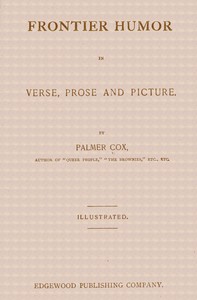
For Frontier Humor in Verse, Prose and Picture — A Closer Reading, the stored edition analysis reports 80,840 words, 5 hr 52 min estimated reading time, and 85 detected text sections.
The text analysis averages about 23.9 words per sentence, while the detected sections provide another way to judge how the source is divided.
Project Gutenberg metadata also associates the work with “Canadian wit and humor,” connecting these edition facts with the source record’s subject description.
Explore this collection
These alternatives are selected using recorded categories and estimated reading time.
About 384 minutes
Science Fiction Utopias
88,236 recorded words. 32 minutes difference from this book's estimate.
View Gutenberg source #12581About 394 minutes
Science Fiction Utopias
90,535 recorded words. 42 minutes difference from this book's estimate.
View Gutenberg source #6880About 306 minutes
Science Fiction Utopias
70,223 recorded words. 46 minutes difference from this book's estimate.
View Gutenberg source #32274Search stored excerpts and compare books → Choose by your preferences →
Choices use stored catalog measurements. Estimates vary with reading speed. A shared category is a catalog label, not a claim that two books have the same argument or literary quality.
Search reads excerpt text stored with this catalog and links to its associated Gutenberg record. The connection is stored in the site database; this tool does not recheck that every excerpt is word-for-word identical to that external record. Excerpt search does not cover every chapter and does not verify historical publication dates.
Catalog snapshot checked: 2026-09-26. Coverage: 100 public books, 100 available source excerpts.
Calculated from edition completeness, EPUB availability, text structure and catalogue metadata. Not a user rating.
Total of 100 points, scaled to a 2.5-5.0 range. Editions with an empty description or a missing EPUB file are not scored.
Public-domain source text
The source text is kept in the dedicated reader, separate from this catalogue record and its commentary.
Palmer Cox's Frontier Humor in Verse, Prose and Picture (1889) collects comic pieces that rely heavily on dialect, tall-tale exaggeration, and physical mishaps. The table of contents lists over sixty items, including poems like "Ode on a Bumble-bee" and prose narratives such as "Dudley's Fight with the Texan." The excerpts show a recurring narrator, Jim Dudley, whose first-person yarns are framed as oral performances—he "called again last night, and, as usual, bored me with one of his yarns." This framing device suggests the book's humor is built on conversational storytelling rather than plot-driven fiction.
The excerpts reveal a strong emphasis on vernacular speech. Jim Dudley's monologues are rendered in nonstandard spelling and grammar: "Wal, 'tain't to be wondered at when you know how I wrought upon his feelin's once." The dialect is not merely decorative; it drives the humor by contrasting Dudley's folksy perspective with the more refined narrator who introduces him. The publisher's preface also uses a rhetorical style—"Happy is the man who can see the humor which bubbles up in daily life"—that echoes the oral tradition of the yarn. This suggests the book may be read as a performance text, where the reader is invited to imagine the storyteller's voice and gestures.
Jim Dudley appears in multiple excerpts, often recounting fights or disputes. In "Dudley's Fight with Dr. Tweezer," the conflict arises over a neighbor's chickens getting into a garden. The humor derives from Dudley's elaborate description of the hens' death throes—"flip-floppin' around, stannin' on thar heads, and then on thar tails"—and his subsequent brawl with the doctor. Other pieces, such as "Dudley and the Greased Pig" and "Dudley's Fight with the Texan," suggest a series of comic misadventures centered on this character. The book's structure may thus resemble a loose cycle of stories rather than a unified narrative, with Dudley as a recurring figure whose exploits are framed by an unnamed listener.
The title promises "Picture" alongside verse and prose, and the excerpts include references to illustrations (e.g., "GOING FOR THE DOCTOR" appears as a caption). Although the digital text does not reproduce the images, the captions and the publisher's note that Cox "pictures all the fun" indicate that visual gags are integral to the humor. The table of contents lists 85 sections, many of which likely pair text with drawings. Readers should be aware that the Project Gutenberg edition may not include the original illustrations; the cover image was created by the transcriber. The humor in the excerpts is often visual in description—such as the hen "stannin' on thar heads"—suggesting that the pictures would amplify the slapstick.
Readers approaching Frontier Humor should expect a miscellany of short pieces best sampled rather than read straight through. The dialect may require slow reading, but the rhythm of the yarns rewards attention to wordplay. The catalog subject "Canadian wit and humor" fits the setting—San Francisco, Benicia, and frontier towns appear—but the humor is broader than regional satire, leaning on universal comic types: the boastful storyteller, the vengeful neighbor, the hapless farmer.
There’s something touching about the way Palmer Cox’s dialect humor leans on the absurd, almost tenderly, as if laughing alone kept the cold frontier at bay. That same gentle, self-aware chuckle lingers in Baboo Jabberjee, B.A. — Inside the Classic, where language trips over itself and the heart stays perfectly steady. I thought of that old book’s quiet charm while turning these pages, and felt oddly grateful for both.
Capture what you thought, learned, and would like to remember.









