About 27 minutes
The three sisters [Night watches, Part 6.] — A Closer Reading
Adventure Picaresque Fiction
6,011 recorded words. 4 minutes difference from this book's estimate.
View Gutenberg source #12156
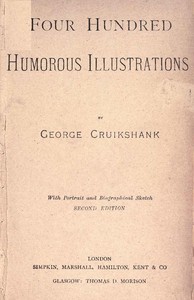
For Four Hundred Humorous Illustrations, Vol. 2 (of 2) With Portrait and Biographical Sketch — A Reader’s Guide, the stored edition analysis reports 5,098 words, 23 min estimated reading time, and 3 detected text sections.
The text analysis averages about 26.4 words per sentence, while the detected sections provide another way to judge how the source is divided.
Project Gutenberg metadata also associates the work with “English wit and humor, Pictorial,” connecting these edition facts with the source record’s subject description.
Explore this collection
These alternatives are selected using recorded categories and estimated reading time.
About 27 minutes
Adventure Picaresque Fiction
6,011 recorded words. 4 minutes difference from this book's estimate.
View Gutenberg source #12156About 35 minutes
Adventure Picaresque Fiction
7,863 recorded words. 12 minutes difference from this book's estimate.
View Gutenberg source #46374About 59 minutes
Adventure Picaresque Fiction
13,468 recorded words. 36 minutes difference from this book's estimate.
View Gutenberg source #71166Search stored excerpts and compare books → Choose by your preferences →
Choices use stored catalog measurements. Estimates vary with reading speed. A shared category is a catalog label, not a claim that two books have the same argument or literary quality.
Search reads excerpt text stored with this catalog and links to its associated Gutenberg record. The connection is stored in the site database; this tool does not recheck that every excerpt is word-for-word identical to that external record. Excerpt search does not cover every chapter and does not verify historical publication dates.
Catalog snapshot checked: 2026-09-26. Coverage: 100 public books, 100 available source excerpts.
Calculated from edition completeness, EPUB availability, text structure and catalogue metadata. Not a user rating.
Total of 100 points, scaled to a 2.5-5.0 range. Editions with an empty description or a missing EPUB file are not scored.
Public-domain source text
The source text is kept in the dedicated reader, separate from this catalogue record and its commentary.
The biographical sketch opening this volume presents George Cruikshank's early life in a brisk, factual tone, noting that his parents were 'of Scotch nationality' and that his mother was 'a person of energetic temper and strong will.' The narrative moves quickly through family moves, schooling, and the father's death in 1811, establishing a rhythm of concise statements. However, the text then abruptly shifts into a repetitive sequence of the word 'Enlarge' spanning multiple lines, creating a stark contrast in pace. This structural choice—from measured biography to mechanical repetition—invites reflection on how the volume balances informative prose with the visual emphasis of its illustrations.
The biographical sketch compresses decades into a few paragraphs, using short, declarative sentences. For example, it states that the boys 'went to school at Mortlake, and afterwards to Edgeware, but not for long, so that they owed little to school masters.' This economical style conveys information without elaboration, mirroring the directness often found in nineteenth-century reference works. The sketch also includes specific details—such as the mother attending 'the Scotch Church in Crown Court, Drury Lane'—that ground the narrative in precise locations. Yet the pace remains uniform, with no dramatic emphasis on events like the elder brother's return after being presumed dead. The effect is a controlled, almost detached recounting that prioritizes facts over emotional weight.
After the biographical section, the text devolves into a long string of the word 'Enlarge' repeated over thirty times. This section has no punctuation or variation, creating a visual and rhythmic monotony that contrasts sharply with the preceding prose. The repetition seems to function as a placeholder or instruction for image scaling, but its inclusion in the main text disrupts the reading flow. This juxtaposition highlights the volume's dual nature: it is both a narrative about the artist and a catalog of illustrations. The abrupt shift in pace—from measured sentences to a mechanical list—forces the reader to recalibrate expectations, underscoring the tension between textual explanation and visual presentation.
The repeated 'Enlarge' commands create a staccato rhythm that mimics the act of viewing illustrations sequentially. Each 'Enlarge' could correspond to a plate, suggesting a one-to-one relationship between text and image. However, the lack of descriptive captions or transitions leaves the reader to infer the connection. This pacing choice is unusual for a biographical volume; it prioritizes the visual catalog over narrative continuity. In contrast, the earlier biographical sketch uses varied sentence lengths and specific details to maintain interest. The shift from varied to uniform pacing reflects a broader editorial decision to let the illustrations speak for themselves, with the text serving as a minimal guide. Readers may find this abrupt change jarring, but it also emphasizes the primacy of Cruikshank's visual work.
Readers approaching this volume should be prepared for its hybrid structure: a concise biographical sketch followed by a repetitive visual index. The pacing shifts dramatically, and the text offers little mediation between narrative and catalog. To appreciate the work, consider how the rhythm of the words mirrors the act of flipping through plates. The biographical details provide context, but the true focus remains on the illustrations themselves.
The rain kept time with page turns, and Cruikshank’s gags felt quieter in that gloom—more catalog than comedy. Then his awkward Victorian pacing nudged me to wonder how American humorists handled rhythm. That’s how I landed on Traits of American Humour, Vol. 2 of 3 — Text and Context, its folksy cadences a warmer, slower companion for the afternoon.
A brief reflection can help important ideas stay with you longer.




![Cover of The three sisters [Night watches, Part 6.] — A Closer Reading](https://ujayu.com/storage/media/covers/pg12156.jpg)




